
5 Takeaways from AI Week Milan to Navigate the AI Stack
June 03, 2026
By Anastasiia D.
AI in Production,
AI Maturity
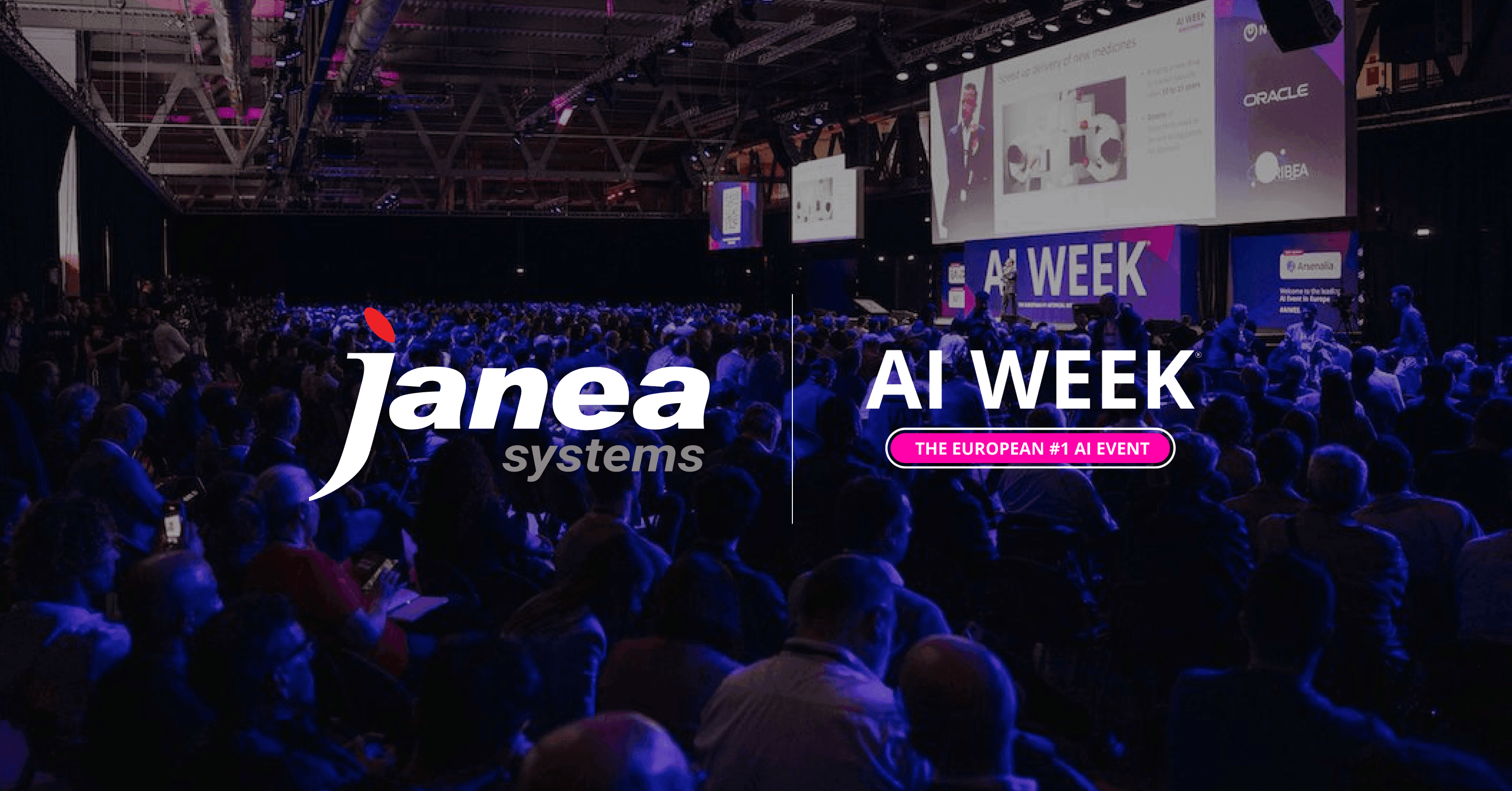
AI Week Milan, held at Fiera Milano Rho, is Europe's largest AI event. It draws 25,000+ professionals, 250+ exhibitors, and 700 speakers across 17 stages. Our Head of Marketing, Sergey Cujba, attended the event and came back with a few takeaways.
Two years ago, conferences were selling capability. In Milan, every serious speaker was selling discipline: data readiness, governance, and reliability. Jones essentially said the model is no longer your bottleneck. That matches what our engineers see in the field.
What was the core message of AI Week Milan 2026?
In one line: the value in AI has shifted from the model to the system that surrounds it. Keynote speakers, including Llion Jones, Alex Mashrabov, Michele Catasta, Karen Hao, and Lucilla Sioli, described a different layer of that system. Stacked together, they form a single roadmap for industrial-grade AI: stabilized architectures, human-led creative differentiation, agentic development, material and geopolitical constraints, and sovereign governance.
Here's our recap of the keynotes that any organization implementing AI needs to know. If you’re trying to get any returns from AI in 2026 or 2027, this is for you.
The model isn't your bottleneck anymore
Some background is warranted here, because Llio Jones's authority on this point is unusual. He is one of the eight authors of the 2017 Google paper that introduced the Transformer, the scaled dot-product attention mechanism that underwrites essentially every large language model in production today. He has since left Google to co-found Sakana AI, where he is a CTO.
What’s so unique about his keynote? When the person who helped invent the architecture tells you the architecture has stopped being where the action is, it is worth listening.
According to Jones, the attention mechanism has matured from a research breakthrough into standardized infrastructure, the way TCP/IP or the relational database did before it. The primary barrier to enterprise adoption is no longer the raw intelligence of the model. It is the readiness of the surrounding systems: data pipeline maturity, integration middleware, and reliable governance. Future value, in other words, accrues to the implementation layer, rather than the model parameters.
This is the insight our engineers have been documenting for the last two years. In The Silent Killers of AI ROI, we mentioned how a model with 94% test accuracy can still collapse under production load because of bottlenecks nobody profiled. The cure is rarely a better model; it is better engineering around it.
When Microsoft Bing Maps ran its DeepCAL geocoding model, the TensorFlow implementation ran 10x slower than the PyTorch equivalent. Not because of intelligence, but because fixed-length encodings inflated file sizes and blocked parallel I/O. We refactored the pipeline, accelerated TensorFlow inference 50x, and cut training time 7x. The model's IQ never changed. The system around it did.
Ready to find the silent killers in your AI pipeline?
Talk to our MLOps engineers to diagnose and eliminate the production bottlenecks that quietly destroy AI ROI.
Agentic development and vibe coding
Michele Catasta is the President and Head of AI at Replit, the browser-based development platform that has become one of the loudest proving grounds for AI-assisted coding. Before Replit, he led applied research at Google, so he watched this shift from inside the tools that drive it. His keynote declared that autonomous agents have crossed from future projection into operational reality.
His keynote centered on the macroeconomics of vibe coding. According to him, a single developer's output is amplified exponentially, small teams reach the output density once reserved for mid-sized firms, and software pricing drifts from seat-based subscriptions toward outcome-based contracts, because customers increasingly buy finished business outcomes rather than the platform that produced them.
It is a compelling vision, and it comes with a caveat we have earned the hard way. In Vibe Coding vs. System Stability, our engineers laid out why fast AI-generated code so often fails the moment it meets real load.
Catasta is right that agentic development democratizes creation. But democratized creation also threatens to flood the landscape with brittle, unprofiled code, which makes the disciplines that stabilize that code more valuable, not less.
There is technical debt that accumulates from AI coding, and this debt needs to be acknowledged by decision-makers. In the first months, AI coding looks like a clean win: features ship faster, and the cost curve bends in your favor. The bill arrives later. Six months on, the same teams are paying it back with interest, fixing technical debt and re-architecting the system. The time and money saved up front migrate into rework.
When models commoditize, human discernment becomes the barrier
Alex Mashrabov's credibility in commoditization is firsthand. He was Director of Generative AI at Snap. He arrived when Snap acquired his startup, AI Factory. Now he runs Higgsfield AI, a generative video company. He has watched generative models go from scarce to ambient, and his keynote was an argument about what is left to compete on once the models themselves are cheap.
His thesis: once foundational models commoditize, raw text-to-video becomes a low-margin API. Durable advantage shifts upstream to whoever can encode human discernment (aesthetic taste, cultural heritage, domain judgment) directly into the software. He demonstrated it with high-fidelity campaigns for luxury houses like Dolce & Gabbana and GCDS, and with Hell Grind, a film he presented as produced entirely through generative video, with granular control over camera tracks and direction rather than blind prompting.
The same idea applies far beyond video. The companies that win are the ones that build their hard-won human expertise into the software.
Our work on the AI clinical workflow platform comprised ambient transcription, context-aware clinical notes, insurance-ready medical coding, and prior authorization. Every AI-generated summary was validated against a human oncologist’s judgment. The result was roughly 80% less documentation time and about two hours reclaimed per physician per day. This outcome does not come from a model, but from embedding human expertise into the system that wraps it.
The AI economy is physical, not virtual
Author Karen Hao supplied the counterweight, and she is well-positioned to. She is the journalist who broke much of the early accountability reporting on OpenAI for MIT Technology Review, and her book “Empire of AI: Dreams and Nightmares in Sam Altman's OpenAI” is the basis for the argument she brought to Milan.
Stripped of its digital mystique, AI is a resource-extractive industry. Hyperscale data centers consume local water reserves for cooling and strain regional power grids. The RLHF and data-labeling pipelines that make models safe lean heavily on low-wage workers in countries like Kenya. The scramble for compute, clean energy, and mineral rights is already reshaping land and resource politics in regions like Chile.
Her sharper point, easy to miss under the infrastructure detail: whoever controls compute, knowledge, and proprietary training data ends up dictating the terms, which makes sovereignty over those resources a national-level concern.
For practitioners, compute and power are constraints you must engineer around. This is why edge and on-device AI matter. In Four Power Management Strategies for Battery-Bound Edge Devices, we detailed how to run ML workloads under hardware and power limits.
Our work with OtoNexus brought it to ground. To transition their handheld ultrasound device from prototype to production, we implemented temperature-aware charging control, low-power standby state machines, and a Python-to-C++ code-generation script that runs ML inference directly on the device. That's AI that respects physical constraints instead of pretending they don't exist.
Building under strict compute, power, or latency limits?
Let's talk. Our engineers specialize in making ML workloads run reliably from the kernel to cloud.
Sovereign trust becomes a competitive advantage
Lucilla Sioli, Director of the European AI Office, framed regulation not as a brake on progress but as the foundation for a high-trust digital marketplace. Mandatory requirements for high-risk AI deployments are set to take full effect across 27 EU member states by August 2026. The EU AI Act forces documented data provenance, model transparency, and human-in-the-loop oversight, and has catalyzed "Sovereign AI": open-source models deployed locally on secure, air-gapped infrastructure.
For enterprises, transparency and reliability are becoming a sales advantage, not just a compliance cost. We've written about building trust-based architectures in our guide How to Fix LLM Workflow Automation that Breaks in Production.
Sovereign AI runs on open foundations. If you are weighing local, open-source models to keep critical data under your own jurisdiction, our open-source consulting team can help you choose, deploy, and maintain them with confidence.
Navigating the entire AI stack
Here’s the most important takeaway from AI Week Milan 2026. Navigating the AI stack requires getting all the moving parts of an AI system to work together in the right order, rather than fixating on just one (usually the model).
The stack is the set of layers an AI system depends on, bottom to top:
- Data foundations: clean, well-organized pipelines so the model is fed something it can trust. This is the base; everything rests on it.
- Operational discipline: the engineering (testing, monitoring, profiling, governance of generated code) that keeps the system from breaking under real production load.
- Differentiation layer: your domain expertise and human judgment built into the system, which makes it valuable rather than generic.
- Physical + governance envelope: the constraints it all has to run inside: finite compute and power, plus legal requirements like data provenance, human oversight, and keeping data where regulators require.
The model sits near the top of this stack, not at the center. Skip any one of these, and the layers above it inherit the failure. That's the maturity gap we mapped in How to Close the Enterprise AI Maturity Gap in 2026.
AI Week in Milan confirmed the through-line our engineers have argued all year: AI value is now a production-engineering problem. With more than 20 years of building mission-critical systems for clients like Microsoft, Merck, and Cognex, Janea Systems bridges AI strategy and technical execution, from data pipelines to edge deployment to sovereign, production-grade governance.
Start with our AI Readiness & High-Level Assessment Workshop. In 2-3 days, we map out your highest-value AI use cases, assess your data and infrastructure, and deliver a prioritized roadmap with quantified ROI.
Contact us today and make 2026 the year your AI investment finally pays off.
Related Blogs
Let's talk about your project
Let's talk about your project
Ready to discuss your software engineering needs with our team of experts?