
How to Close the Enterprise AI Maturity Gap in 2026
January 14, 2026
By Anastasiia D.
AI Maturity,
AI in Production,
Enterprise AI,
AI Roi
By 2026, many companies claim to be “AI-driven.” In reality, only a small fraction of organizations have AI systems that reliably operate at scale and deliver ROI.
The rest will be stuck in an expensive middle ground: pilots that never reach production, proofs of concept that impress in demos but collapse in production, and AI initiatives quietly abandoned without delivering value.
This growing divide has nothing to do with ambition or tooling. It’s about AI maturity and the gap between organizations that can operationalize AI and those that can’t.
In this guide, we unpack:
- The current state of AI maturity across organizations
- What separates high-maturity enterprises from the rest
- The challenges holding low-maturity teams back
- Practical strategies to close the gap between investment and AI ROI
If your organization is serious about moving beyond experimentation, this guide will help you understand where you stand and what it will take to move forward. Let’s begin.
The State of AI Maturity in 2026
Across industries, AI project outcomes have been mixed. On one hand, enterprises are investing heavily in AI pilots and generative AI tools – the enterprise AI market alone is projected to reach $347 billion in 2026, with an annual growth rate of 37%. On the other hand, a shocking proportion of these projects never reach fruition.
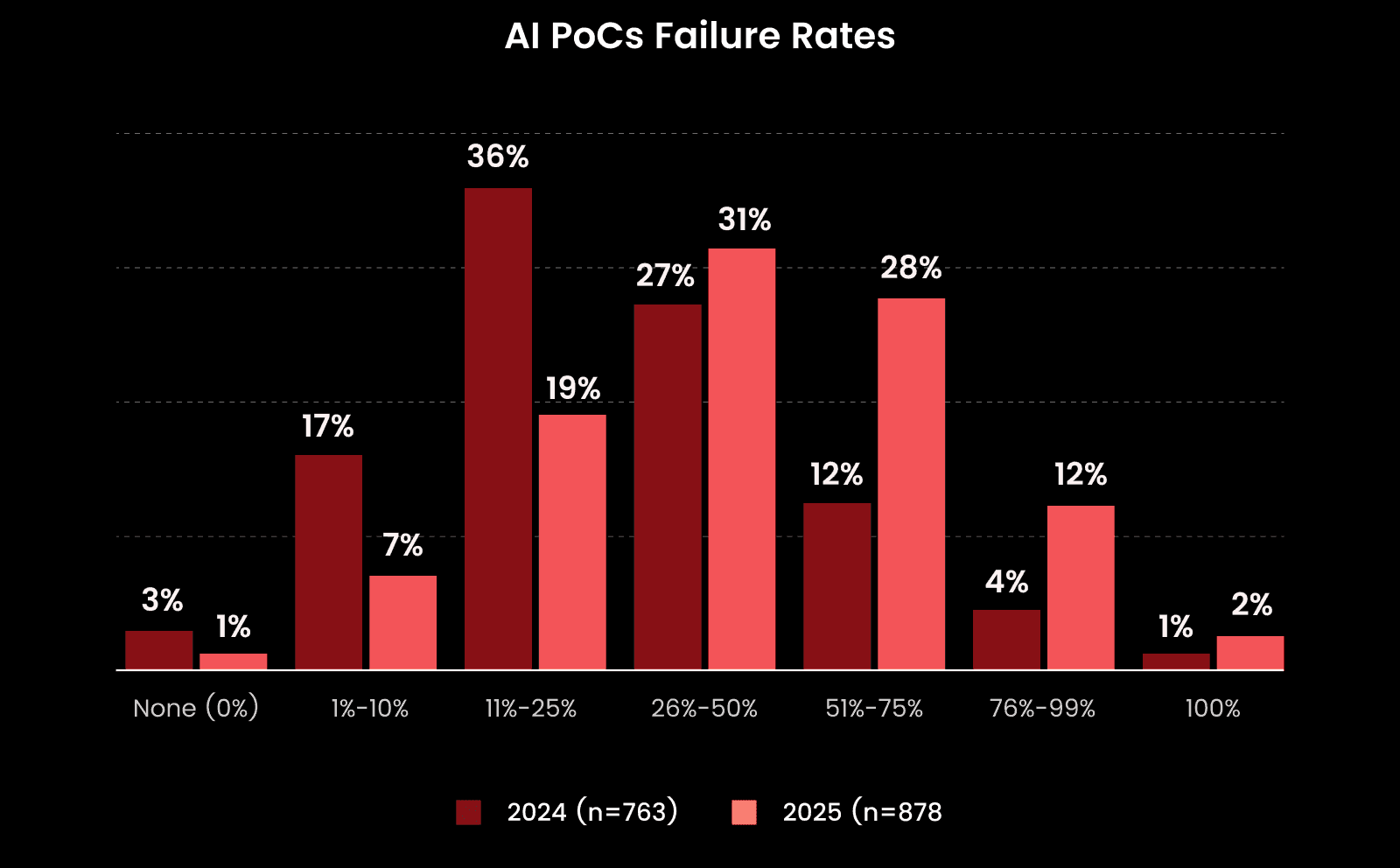
Nearly 42% of companies abandoned their generative AI initiatives in 2025 — up from 17% the year before. As teams move beyond lightweight “wrapper” applications, such as internal chatbots, and attempt to deploy AI in mission-critical workflows, failure rates climb. On average, organizations now discard almost half (46%) of their AI concepts before they reach production.
Even among AI projects that do launch, the benefits often fall short of expectations. 46% of companies report no single enterprise objective has seen a “strong positive impact” from their AI initiatives, while only 19% report strong positive impacts across most objectives (S&P Global).
In other words, nearly half of organizations have yet to realize significant ROI or a competitive edge from AI, even as they pour resources into these technologies. Many early AI investments simply “have not met their lofty expectations,” leading to a split between organizations that can effectively leverage AI (the “cans”) and those struggling to do so (the “cannots”).
What Is AI Maturity?
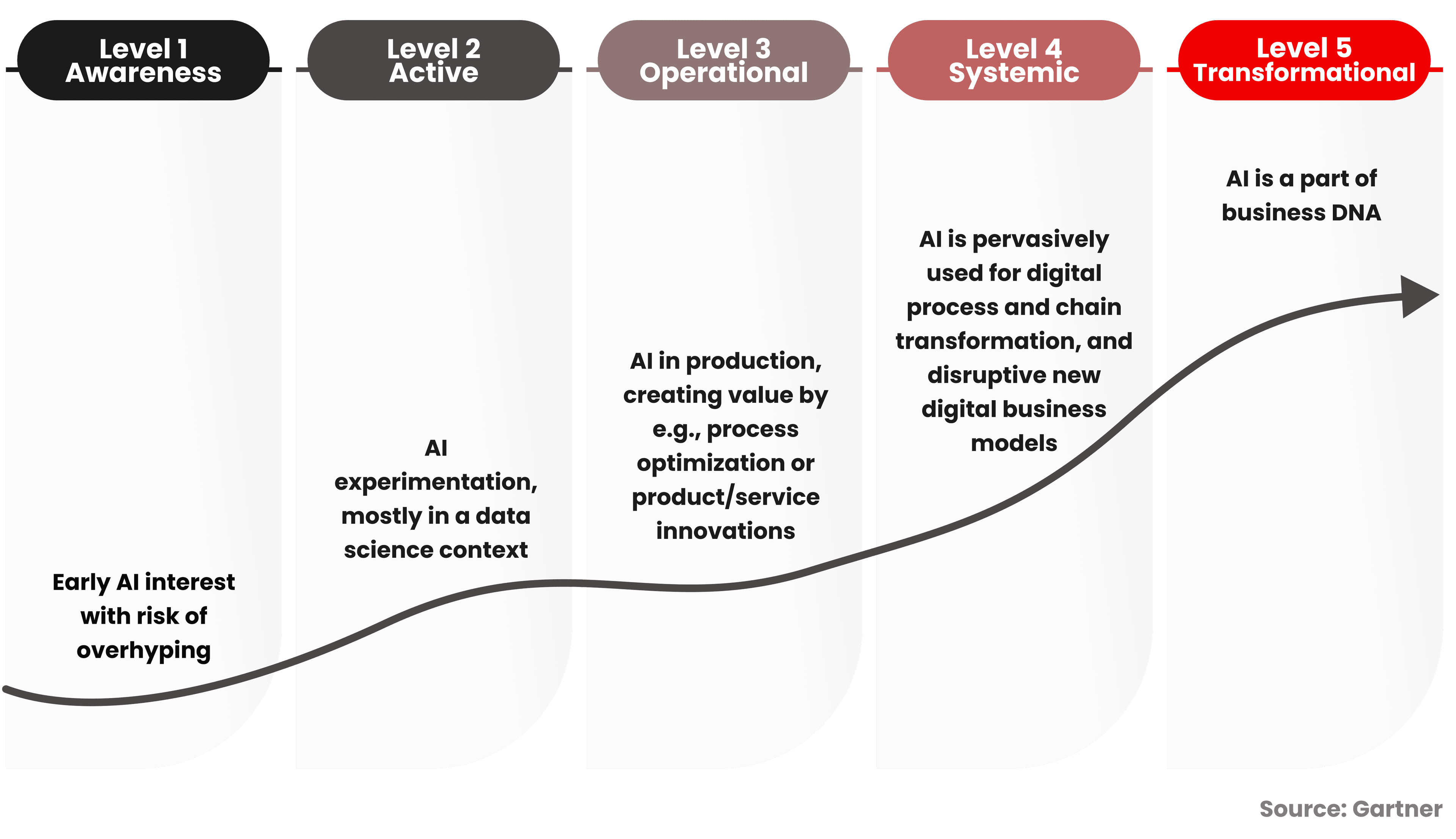
AI maturity is the capability to implement AI technologies in a repeatable, scalable, and value-driven way. Gartner’s AI Maturity Model describes how organizations evolve in their use of AI, from early awareness to transformative impact. The model has five levels, each defined by how AI is adopted, governed, and embedded into the business:
- Awareness: The organization recognizes AI’s potential but has not yet adopted it.
- Active: Teams run small AI experiments and pilots in isolated areas.
- Operational: AI models are in production and delivering measurable value.
- Systemic: AI is scaled across the enterprise with shared platforms and governance.
- Transformational: AI fundamentally reshapes the business and competitive strategy.
Based on this model, organizations fall into one of the two categories:
- A low-maturity enterprise might be at Level 1, experimenting with isolated AI proofs of concept or planning its first use cases.
- A high-maturity enterprise scores near Levels 4-5, meaning AI is fully integrated into its operations with strong leadership and governance.
In Gartner’s recent global survey, high-maturity organizations averaged level 4.2-4.5 on this scale, while low-maturity organizations averaged only about 1.6-2.2.
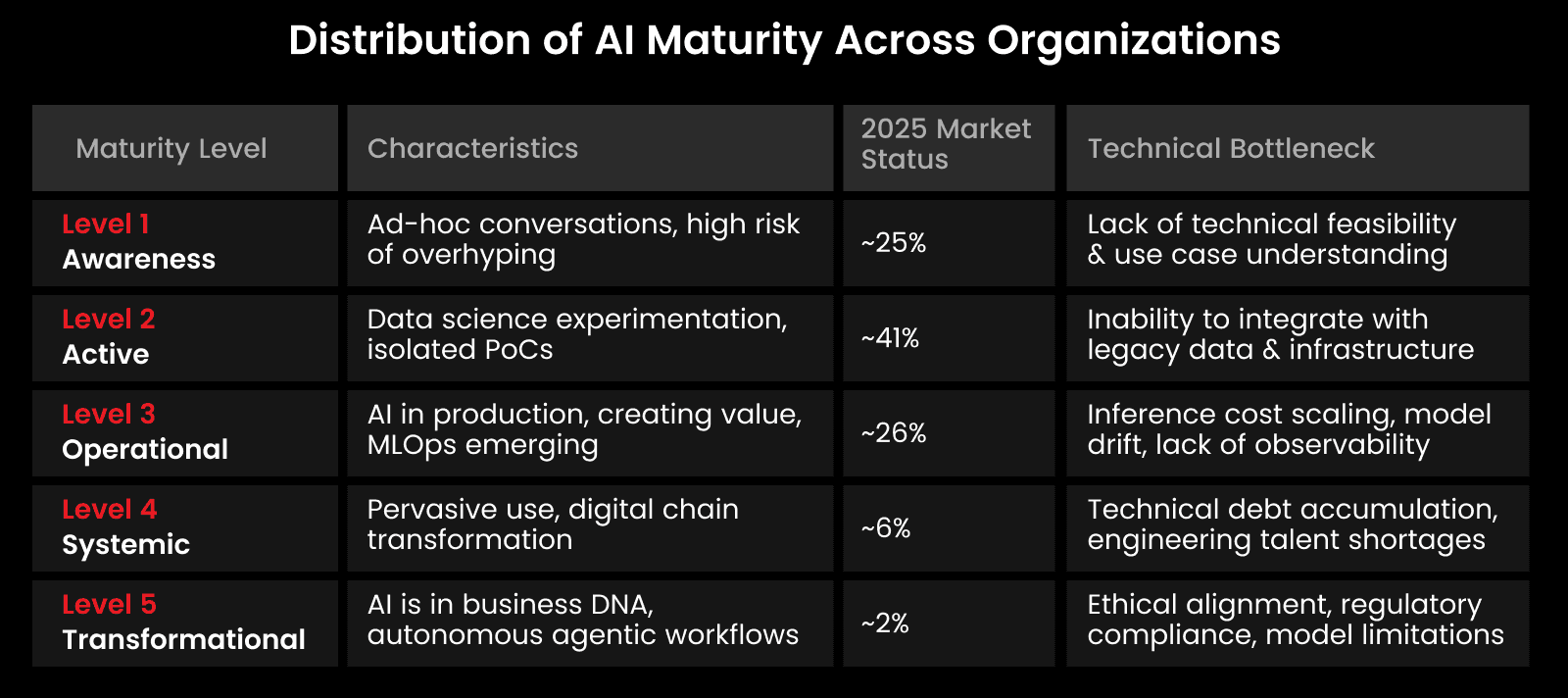
The difference between high and low-AI-maturity organizations directly affects business outcomes.
High-Maturity Organizations (Gartner Score: 4.2-4.5)
High-maturity enterprises treat AI as a core capability rather than a series of one-off projects. Their hallmarks include:
- Dedicated Leadership: 91% have appointed dedicated AI leaders responsible for infrastructure, architecture, and team building.
- Strategic Centralization: Nearly 60% have centralized their AI strategy, governance, and data capabilities to drive efficiency.
- The Trust Factor: 57% of business units in high-maturity orgs trust and are ready to use new AI solutions.
As a result, 45% of high-maturity organizations keep their AI projects operational for 3 years or longer, compared to only 20% of low-maturity organizations.
Low-Maturity Organizations (Gartner Score: 1.6-2.2)
By contrast, low-maturity organizations often lack the abovementioned structures. They remain stuck in the experimental phase, with ad-hoc projects that aren’t aligned with business strategy or supported by enterprise-grade engineering.
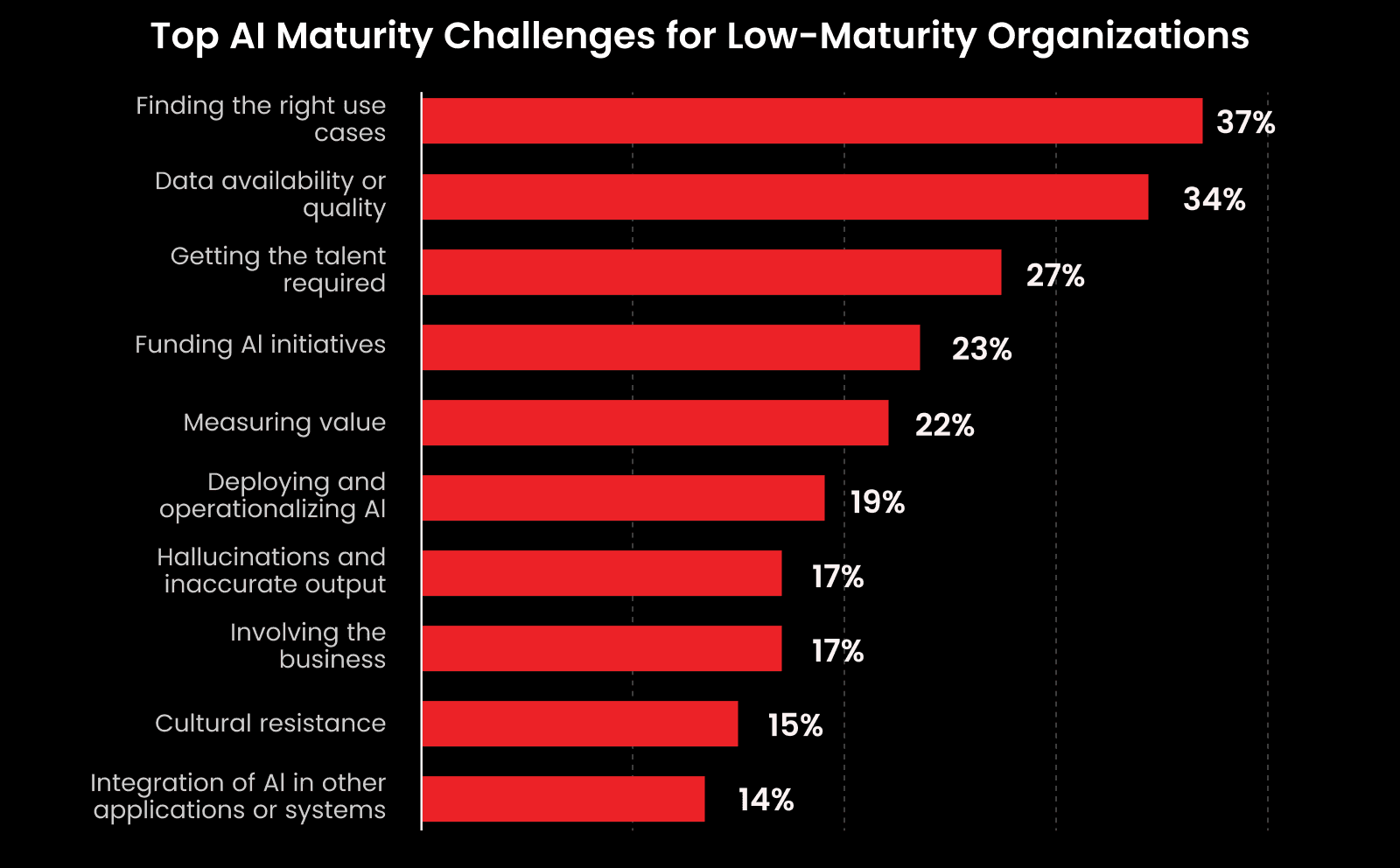
For enterprises at the lower end of the AI maturity spectrum, certain challenges tend to stand in the way of scaling AI initiatives:
- Finding the Right Use Case: 37% of low-maturity leaders cite identifying the right use case as their primary barrier. Without a clear link to business value and technical feasibility, projects fail to gain traction.
- Data Availability and Quality: This remains a universal struggle. 34% of low-maturity organizations identify poor data quality as a top implementation barrier, preventing models from delivering reliable results.
- Infrastructure and Talent Gaps: Half of these organizations admit they lack the technical data stack readiness and the specialized talent needed for complex deployments, such as agentic AI.
- The Trust Deficit: Only 14% of business units in low-maturity companies trust AI solutions. This lack of adoption ensures that even technically sound projects fail to generate value.
Recognizing these pain points is the first step; the next is finding the right expertise and strategies to overcome them.
Strategic Recommendations for Breaching the AI Maturity Gap in 2026
Bridging the divide between Levels 1-2 and Level 4 of AI maturity requires an engineering-first approach to address misaligned data architectures, scalability challenges, and the transition from PoCs to production-ready systems.
Just as importantly, it requires a shift in how organizations think about AI. That means moving away from one-off experiments and toward AI in production, evolving from standalone models to fully integrated AI systems, and replacing technology-first decisions with strategy-led execution. This shift doesn’t happen on its own, and it’s exactly why structured, capability-focused intervention matters.
As we’ve explored in more detail in our article on how businesses succeed with AI, organizations that make this transition deliberately are far more likely to turn AI investments into lasting business impact.
1. Anchor AI to Business Strategy, Not Tools
Enterprises often adopt generative AI platforms, foundation models, or automation tools without clearly defining how those tools support revenue growth, cost reduction, or risk mitigation.
High-maturity organizations reverse this approach. They:
- Define 2–5 enterprise-level AI objectives (e.g., margin improvement, cycle-time reduction, decision automation)
- Map AI initiatives directly to measurable KPIs
- Treat AI as a portfolio of investments, not a collection of experiments
This strategic anchoring is critical because, as S&P Global shows, nearly half of AI initiatives are abandoned before production due to unclear value justification. AI programs that survive are those that start with a business case strong enough to justify long-term operational investment.
Establish a north star and prioritize only those use cases that can realistically reach production within 6–12 months.
2. Close the PoC-to-Production Engineering Gap
The most expensive point of failure in enterprise AI is the transition from proof of concept to production. Low-maturity organizations often underestimate:
- Data pipeline complexity
- Infrastructure costs at scale
- Model reliability in real-world conditions
- Integration with legacy systems
As a result, promising pilots stall indefinitely. This challenge becomes even more pronounced as organizations experiment with agentic AI systems, where orchestration, state management, and reliability requirements increase dramatically.
High-maturity organizations treat AI as software engineering first, data science second. They design for:
- Production-grade architectures from day one
- Deployment automation (CI/CD for ML)
- Cost-efficient inference and scalability
- Observability, monitoring, and retraining
Standardize deployment frameworks and MLOps practices early, even before scaling AI across the enterprise.
If you're serious about moving beyond pilots, our AI & MLOps services will help you establish scalable, cost-efficient deployment and monitoring foundations from day one.
3. Build Data Readiness as a Core Capability
AI maturity is constrained by data maturity. Gartner consistently finds that low-maturity organizations struggle with:
- Siloed data ownership
- Inconsistent data quality
- Lack of shared data standards
- Poor visibility into data lineage and reliability
Without trustworthy, well-structured data, even the most advanced models will fail to deliver value — or worse, produce misleading outputs that erode trust.
High-maturity organizations invest in:
- Data quality assessments tied to AI use cases
- Clear ownership models for critical datasets
- Standardized data pipelines that support both analytics and ML
- Continuous improvement of data foundations, not one-off cleanups
Treat data readiness as an ongoing operational discipline, not a checklist of prerequisites.
If data quality and structure are holding your AI initiatives back, our Data Analytics consultants and engineers will help you assess, redesign, and operationalize data foundations built specifically for AI.
4. Invest in Capability Acceleration
Hiring AI talent alone does not create AI maturity. Many organizations now have data scientists and ML engineers, but still lack:
- Shared architectural standards
- Repeatable delivery processes
- Cross-functional alignment between engineering, data, and business teams
High-maturity organizations close this gap by accelerating capabilities through:
- Targeted workshops and assessments
- External engineering expertise to unblock critical bottlenecks
- Hands-on enablement rather than theoretical training
This is where short, focused interventions can outperform large, slow transformation programs.
Use expert-led maturity accelerators to compress years of trial-and-error into weeks of structured progress.
Janea Systems offers a set of focused AI Maturity Workshops. These short, high-impact engagements are tailored to your current maturity stage and designed to deliver tangible action plans. Each workshop targets a critical capability gap and follows a proven AI Maturity framework for engineering-led intervention that accelerates progress.
Notably, all workshops emphasize practical deliverables – not just advice, but concrete outcomes, including prototypes and AI Maturity roadmaps your team can immediately implement. On top of it, we provide fully managed software engineering teams able to ramp up your AI project in the shortest time possible.
AI Maturity Workshops: From Level 1 to Level 4
At Janea Systems, we focus on helping you move forward in your AI maturity journey, wherever you’re starting from. Based on your current stage and goals, we offer flexible engagement options, including fully funded workshops (on us) or joint investment workshops where we share the cost and commitment.
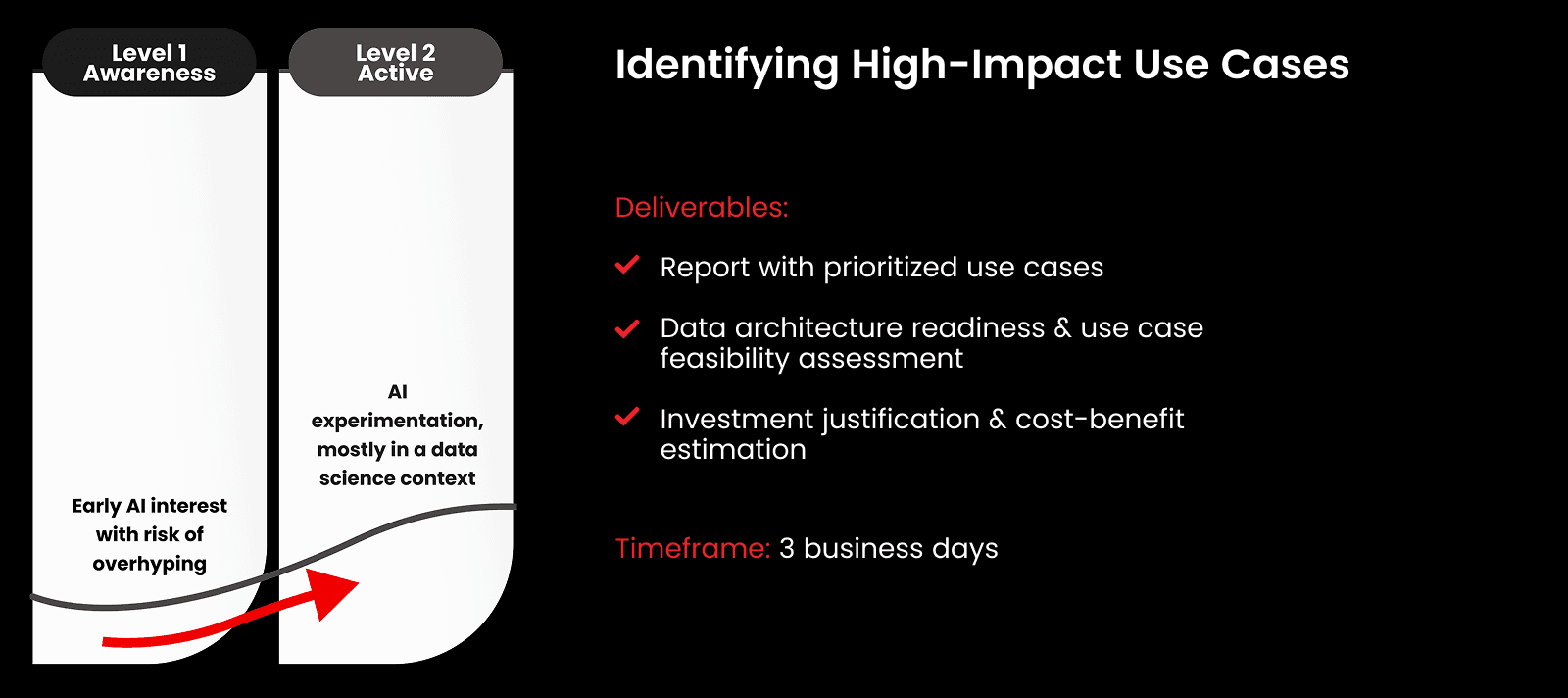
Level 1 to Level 2: Identifying High-Impact AI Use Cases
Challenge: Many organizations start with technology (“We need to use GenAI") rather than a problem. This results in projects that are technically successful but fail to deliver ROI.
AI Maturity framework: In just 3 business days, our experts analyze your processes and data to pinpoint the top 3 AI use cases with the highest ROI potential.
Deliverables:
- Detailed report with prioritized AI use cases
- Data architecture readiness and use case feasibility assessment
- Investment justification and cost-benefit estimation
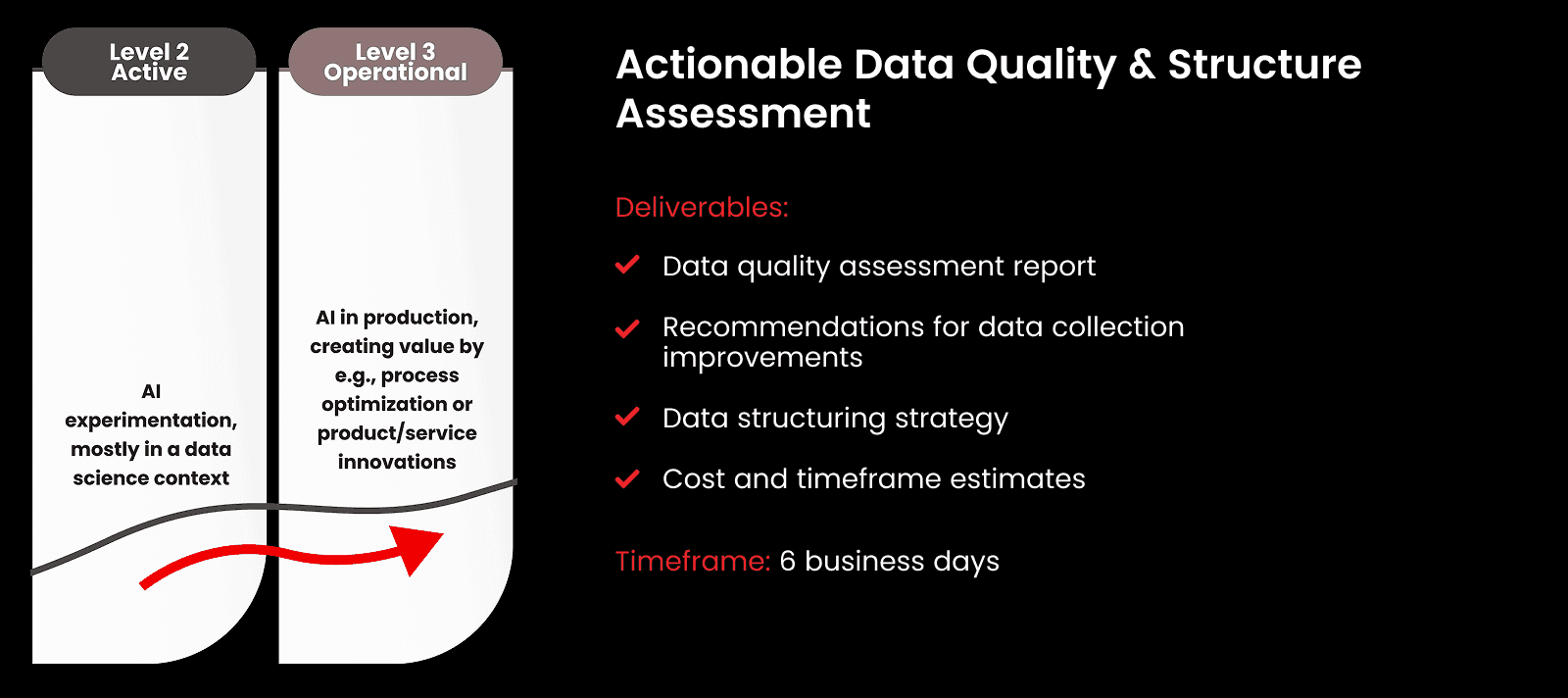
Level 2 to Level 3: Actionable Data Quality & Structure Assessment
Challenge: Your data is siloed, unstructured, or incomplete. Poor data quality is cited by 43-46% of enterprises as the primary barrier to AI. Furthermore, "AI-Ready" data is distinct from "BI-Ready" data. A database might be perfect for a Tableau dashboard but useless for training an LLM because it lacks semantic context or vector embeddings.
AI Maturity framework: This 6-day assessment provides a complete audit of your data collection, formatting, and structure.
Deliverables:
- Data quality assessment report
- Recommendations for data collection improvements
- Data structuring strategy
- Executive buy-in justification with cost and timeframe estimates
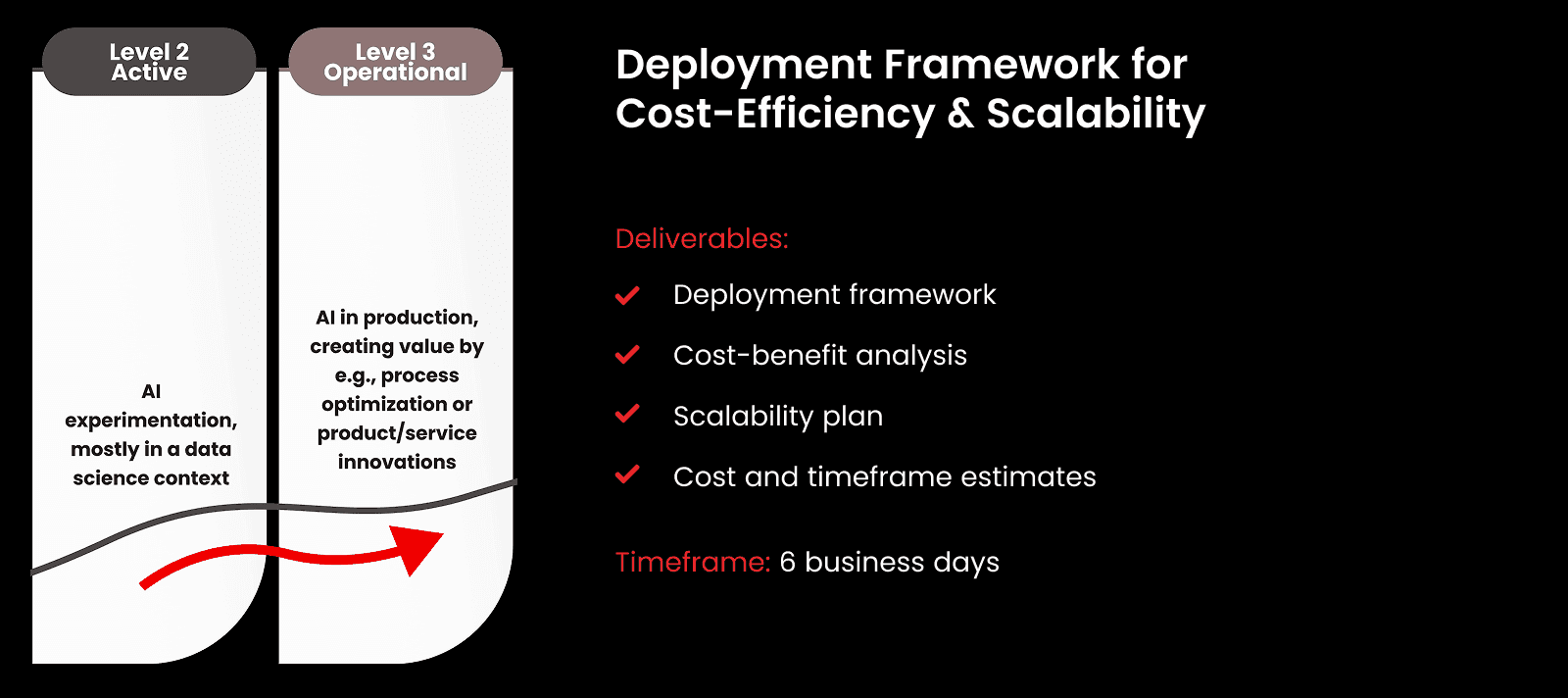
Level 2 to Level 3: Deployment Framework for Cost-Efficiency & Scalability
Challenge: Deploying a model to 10 users is trivial. Deploying to 10,000 users requires handling concurrency, load balancing, and latency. This is where 26% of organizations stall.
AI Maturity framework: In 6 days, we design a robust deployment framework that balances performance with cost-effectiveness for your specific needs.
Deliverables:
- Deployment framework
- Cost-benefit analysis
- Scalability plan
- Executive buy-in justification with cost and timeframe estimates
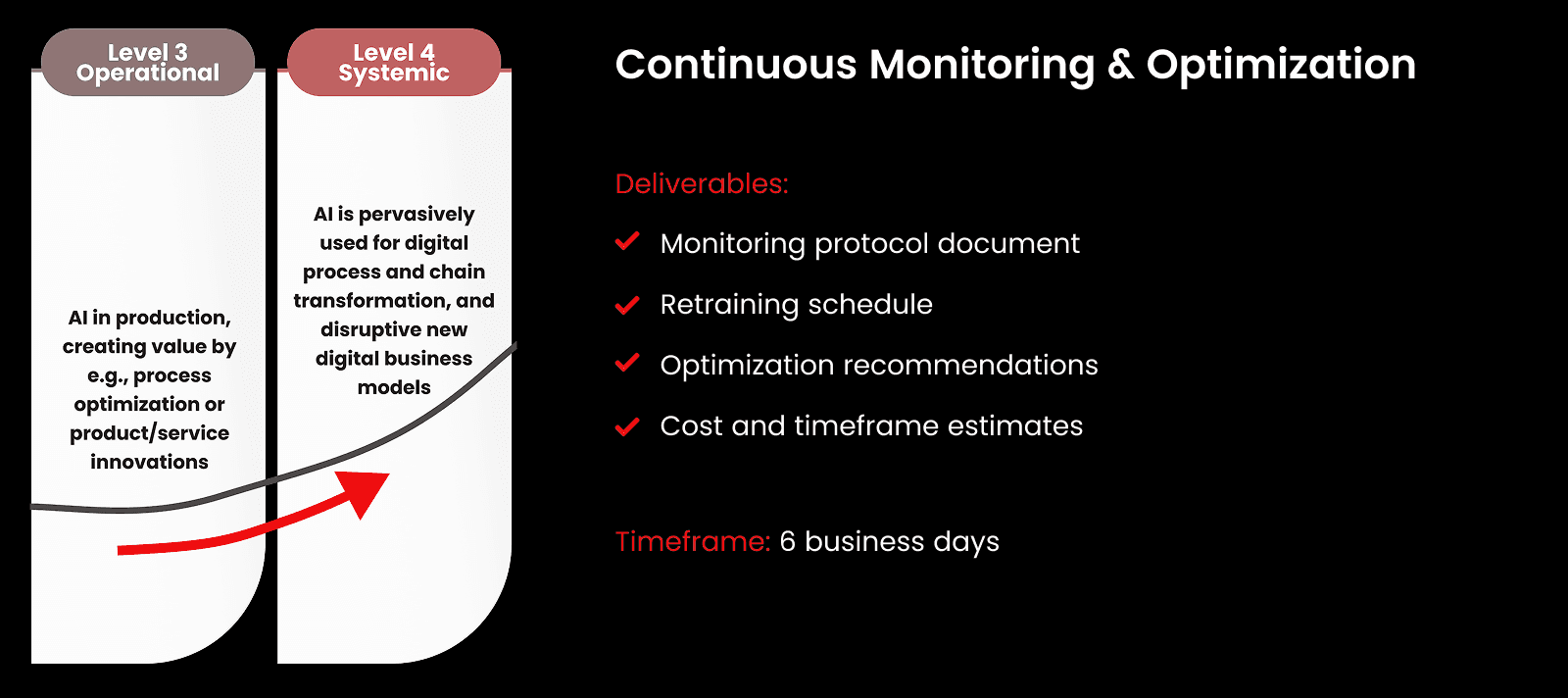
Level 3 to Level 4: Continuous Monitoring & Optimization Protocol
Challenge: AI models are not static assets. Your AI model may perform well in testing, but in production, it degrades over time, and you don't know why.
AI Maturity framework: This 6-day engagement establishes a robust protocol for continuous monitoring, retraining, and optimization.
Deliverables:
- Monitoring protocol document
- Retraining schedule
- Optimization recommendations
- Executive buy-in justification with cost and timeframe estimates
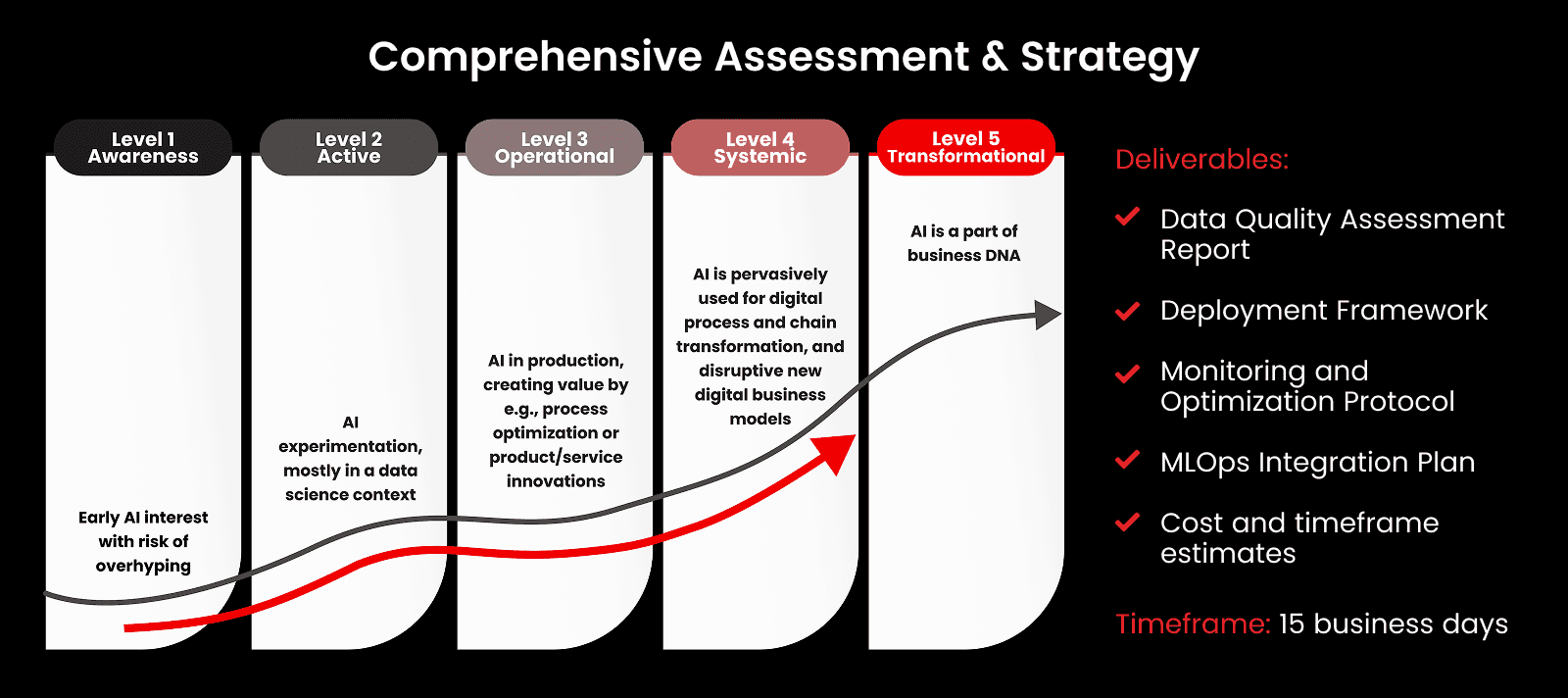
Acceleration from Level 1 to Level 4: Comprehensive AI Maturity Assessment & Strategy
Challenge: You need to scale your AI capabilities but lack an integrated MLOps foundation, which is slowing your time-to-market.
AI Maturity framework: This 15-day comprehensive assessment provides a complete strategic plan to enhance your data quality, deployment, and optimization.
Deliverables:
- Data Quality Assessment Report
- Deployment Framework
- Monitoring and Optimization Protocol
- MLOps Integration Plan
- Executive buy-in justification with cost and timeframe estimates
How to Move from AI Experiments to Enterprise-Scale AI Maturity?
If your organization is stuck between AI pilots and real production value, our AI Maturity Workshops will close this gap, and close it fast.
Book a free AI Maturity Assessment and get a prioritized AI Maturity Roadmap to move from Levels 1-2 to Level 4 with confidence. Complete the form below, and our AI Maturity expert will reach out to you within 48 hours.
Related Blogs
Let's talk about your project
Let's talk about your project
Ready to discuss your software engineering needs with our team of experts?