
Technical Debt in AI Coding: Types, Impact, and How to Measure It
May 27, 2026
By Anastasiia D.
Technical Debt,
AI in Production,
AI Engineering

In our previous article on vibe coding and system stability, we covered the dramatic side of AI-assisted development: the Enrichlead API blowout, Gemini CLI's hallucinated meltdown, and Google Antigravity wiping someone's drive in Turbo mode. Those are the stories that get the headlines because they're loud.
The quieter problem is the one that doesn't crash your production on launch day. It's the slow, compounding accumulation of structural decay inside repositories that are running fine. Until, six months in, your team is spending two-thirds of its sprint capacity on bug fixes, and nobody can explain why.
This article is for the engineering leader who's already past the "should we use AI" debate. You're using it. Your team is using it. Now you need to keep it from quietly rotting your codebase. We'll cover:
- What technical debt in AI coding looks like
- How the AI-generated technical debt differs from the classic technical debt in software development
- The 4 types of technical debt AI assistants generate with technical debt examples
- How to measure technical debt
In a follow-up article, we'll cover how to stop AI debt from entering your codebase and how to reduce technical debt that's already accumulated.
What Is Technical Debt?
Quick refresher for completeness. What is technical debt, in its original sense? The technical debt definition comes from Ward Cunningham in 1992: when you ship code that's not quite right, you're borrowing against future productivity. Eventually, you have to pay interest in the form of slower delivery, more bugs, and harder maintenance. That's the technical debt meaning in its original form, and it's still the cleanest definition of technical debt anyone has produced.
The classic version of technical debt in software development is intentional. A senior engineer looks at a deadline, looks at the architecture, and makes a deliberate call: "We'll hardcode this for now and refactor next sprint." That's a loan you're taking out with your eyes open.
AI-generated debt is different. It's not a trade-off, but a byproduct. LLMs generate code inside narrow context windows with no architectural memory. They optimize for solving the immediate prompt, not for fitting cleanly into the broader codebase. The result is debt that nobody chose to take on. It just appeared.
GitClear's AI Copilot Quality Research analyzed 211 million changed lines across Google, Microsoft, Meta, and major enterprise repos. Between 2021 and 2024, the share of commits representing refactoring activity collapsed from 25% to 9.5%. Over the same period, copy-pasted lines rose from 8.3% of all commits to 12.3%.
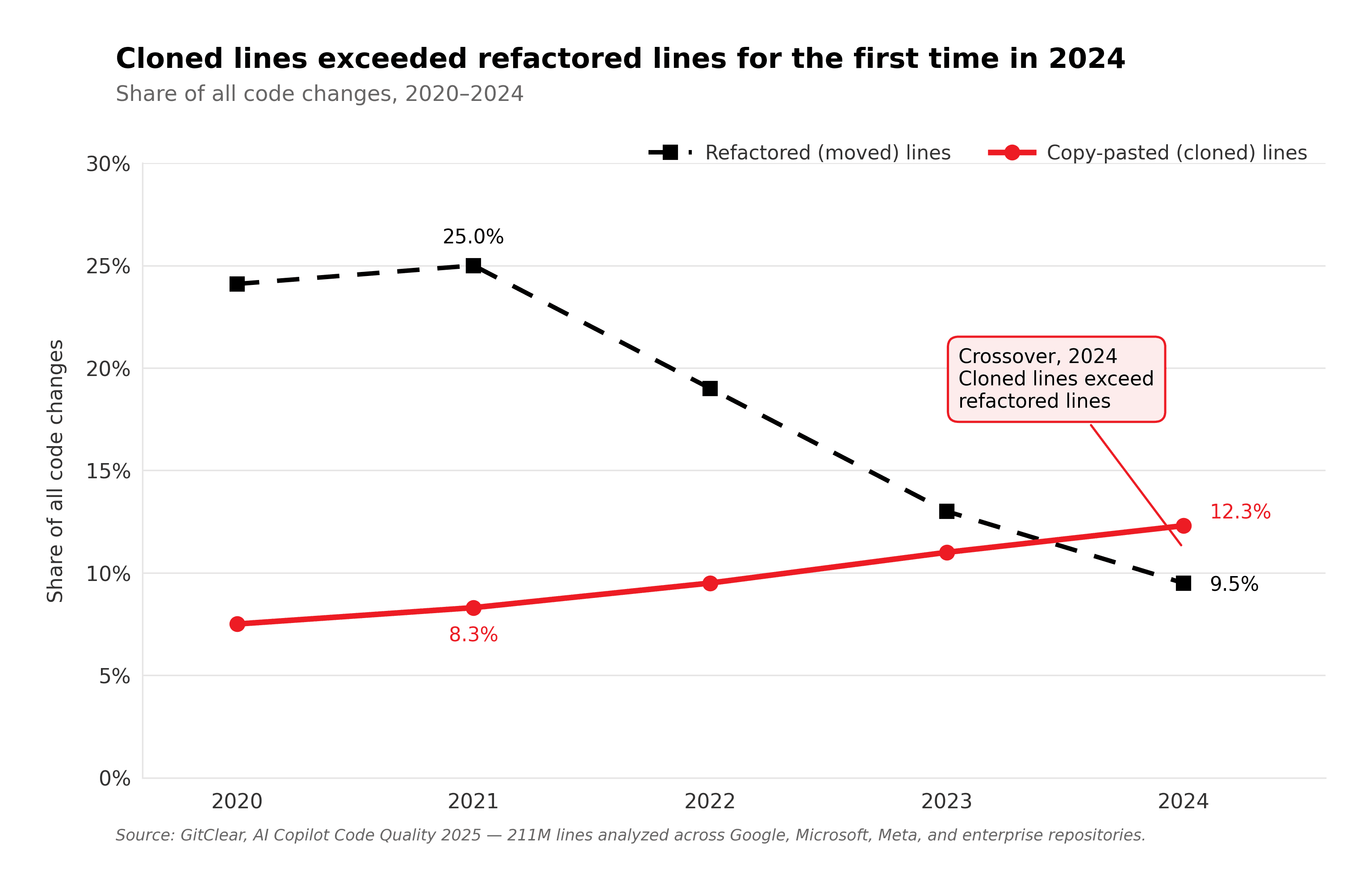
In the same period, 46% of all code changes were net-new lines, while copy-pasted lines overtook moved ones. "Moved" is GitClear's term for code that's been rearranged or relocated, the kind of work you do when you're consolidating logic into a reusable module rather than writing it from scratch.
That movement is the signature of refactoring. When it declines year over year, you can read the trend directly: less consolidation, more duplication, and codebases that grow by accretion rather than by design. Code reuse practice kept codebases healthy for over 20 years. For the first time in the history of software development, cloned lines have exceeded refactored lines. That’s the clearest indicator of technical debt in AI coding at industry scale.
4 Types of Technical Debt AI Assistants Generate
If you want to get serious about managing technical debt from AI assistants, it helps to know what you're actually managing. The four types of technical debt caused by AI coding show up consistently across studies.
The empirical study Debt Behind the AI Boom analyzed 302,579 verified AI-generated commits across 6,299 GitHub repos and identified 484,366 distinct technical issues introduced directly by 5 widely-used coding assistants. The types of technical debt caused by AI include:
- Maintainability debt
- Correctness debt
- Security debt
- Architectural debt
Each one shows up differently in a codebase. Let’s check the technical debt examples below.

Maintainability debt
Maintainability debt accounts for 89.3% of all AI-introduced issues. These are the "code smells" that don't break execution but make future modification miserable:
- bare
except: passblocks that silently swallow errors,open()calls without explicit file encoding (which crash inconsistently across operating system locales),- deprecated function calls,
- unused variables,
- formatting that ignores the existing linter config.
The ArchiveBox project (over 27,000 GitHub stars) received a commit from Claude Code that successfully updated metadata loading logic and simultaneously introduced both a bare-except trap and an unencoded file open. The code worked. It will fail at some point, on someone else's machine, for reasons that take a day to diagnose.
Correctness debt
Correctness debt is the next category: 28,931 functional bugs in the dataset. The top pattern created undefined variables in 23,856 cases. The canonical example is a commit to the firecrawl repo (98,000+ stars) by the Devin agent, which passed cache=cache as a parameter when the cache itself was completely undefined. Result: NameError in production.
Security debt
Security debt is where AI-assisted coding gets genuinely dangerous. Across studies, 40% to 45% of AI-generated code contains a vulnerability mapping to the OWASP Top 10. In Java, the failure rate exceeds 70%.
The 2025 CVE-2025-48757 incident on the Lovable platform is the platform-level version of this debt class: applications were generated with absent or misconfigured Postgres row-level security policies, and 10.3% of analyzed deployments leaked PII, financial records, and hardcoded third-party API keys to anyone who appended ?select=* to the right endpoint.
Architectural debt
Architectural debt is the most insidious because it's invisible in any single PR. It's the cumulative effect of LLMs solving similar problems by emitting similar-but-slightly-different code blocks instead of extracting helper functions.
GitClear tracked an eightfold increase in five-plus-line duplicate blocks since 2022. The related pattern is cyclomatic complexity drift: agents nest conditional logic inline rather than refactoring it out, because their context window doesn't show them the existing helper that would have done the job.
The Impact of Technical Debt from AI Coding
When you talk to a CFO, the impact of technical debt needs to be measured in dollars and delivery velocity, not code aesthetics. Here’s what to look for.
AI-Generated Defects Persist
The assumption that "human review will catch it" is mathematically failing in practice. A recent large-scale empirical study tracking over 300,000 AI-authored commits across five major coding assistants found that more than 15% of all AI-assisted commits introduce at least one issue.
Of the 484,366 AI-introduced issues tracked, 22.7% survived the latest repository revisions. Defects are settling permanently into production architectures, not getting cleaned up downstream. AI systematically injects long-term maintenance debt into the product roadmap at a speed that traditional review cycles cannot keep pace with.
Production Remediation Costs
The business impact is best understood through the project costs. IBM indicates that a bug caught in production costs up to 15 times more to remediate than one identified during the initial development phase.
For a team of 15 engineers with a $200,000 all-in cost per head:
- Baseline Cost: If AI-introduced debt causes just 20% of weekly capacity to be diverted from new feature development (innovation) to debugging production errors, the company is effectively burning $600,000 in annual payroll on "interest payments" for tech debt.
- Opportunity Cost: Every dollar spent on "vibe coding" cleanup is a dollar retracted from product innovation, feature expansion, and competitive differentiation.
Transitioning from "Vibe Coding" to Managed Velocity
The rapid adoption of vibe coding without deep architectural validation creates a fragile ecosystem. When AI generates code without an understanding of the existing context, it creates fragmented, inconsistent, and often redundant workflows that are notoriously difficult to audit.
The benefits of reducing technical debt in an AI-assisted codebase show up as recovered delivery velocity, lower bug-remediation hours, and the absence of emergency rebuilds.
How to Measure Technical Debt in an AI-Assisted Codebase
How do you measure technical debt when half your commits are coming from agents? The honest answer: with different metrics than those you relied on in 2022.
The classic SonarQube-era approach to measuring technical debt (debt ratio, debt remediation index, maintainability grade) was calibrated for human-authored code. It still works, but it under-reports the patterns that matter most when AI is in the loop.
Here are the indicators that correlate with AI-generated decay. Treat them as a starter set for how to measure technical debt in 2026.
Clone density
Structural clone detectors like jscpd cover 150+ languages and catch near-duplicates that string-matching misses. GitClear's industry-average crossed 12% in 2024. That's a useful benchmark threshold for flagging repositories that need refactoring attention.
Cyclomatic complexity drift per PR
Track the delta, not the absolute number. A PR that raises a single function's cyclomatic complexity by three or more is a strong signal that the agent inlined logic that should have been extracted.
Refactor-to-add ratio
Among all changed lines in a sprint, what fraction is moved/consolidated code versus net-new additions? If this trends toward zero, your repo is accreting rather than evolving.
AI-introduced defect survival rate
Tag commits authored or co-authored by AI assistants, then track how many of the defects introduced in those commits still exist 30, 60, and 90 days later. The 22.7% baseline is a reasonable starting threshold for "we have a problem."
OWASP-mapped finding rate per 1,000 lines of AI-generated code
Run static analysis on commits authored by AI assistants and count the security findings that map to an OWASP Top 10 category. Divide by the volume of AI-generated code to get a rate that's comparable across sprints. Slice the results by CWE to see which specific vulnerability classes your AI tools produce most often. That's where prompt scaffolds and review pay off most.
Example: if Copilot wrote 8,000 lines in a sprint and your scanner flagged 12 OWASP-mapped issues in those commits, your rate is 1.5 findings per 1,000 LOC.
Dependency hallucination rate
Track how often suggested imports reference packages that don't exist, get rejected by lockfile enforcement, or trigger your internal proxy. The empirical baseline tested 16 LLMs across 576,000 code samples: 19.7% of all recommended packages were hallucinated, and 43% of the hallucinated names reappeared across reruns of the same prompt.
A practical note: most teams don't need a custom platform for this. What they need is for these signals to surface in the same dashboard the team already looks at every morning. The metrics matter less than whether anyone sees them.
What’s next?
Naming a problem is the first half of solving it. AI-generated technical debt has been treated as an inevitability for the last two years, mostly because nobody had agreed on what it was, where it came from, or how to count it.
That's changing.
The empirical work is now sitting in front of us, the metrics are tractable, and the patterns are clear enough that an engineering leader can walk into a Monday standup and ask the right questions.
If your team is already feeling the weight of an AI-assisted codebase and you'd like senior engineering eyes on it, Janea Systems is ready to assist. Our team comprises senior engineers and 20+ years of experience shipping mission-critical software.
Our recent engagements include:
- PyTorch ARM64 enablement
- Microsoft Bing Maps NLP pipelines
- Pharma R&D platform serving 6,000+ scientists
- A multi-agent analytics platform for sports
Explore our software engineering services and AI and MLOps services, or reach out to talk through your engineering challenges.
Frequently Asked Questions
Code shortcuts you'll pay interest on later, in the form of slower delivery, more bugs, and harder maintenance. The classic version is intentional — a senior engineer makes a deliberate trade-off to ship. The AI-era version is structural — an unintended byproduct of how LLMs generate code inside narrow context windows without architectural memory.
AI assistants tend to produce four recurring categories. Maintainability debt is by far the largest. Correctness debt covers functional bugs, with undefined variables being the dominant pattern. Security debt shows up as OWASP Top 10 vulnerabilities. Architectural debt is the cumulative drag from cloned-but-not-quite-identical code blocks and inlined complexity. Real technical debt examples of each category appear in major open-source repos like ArchiveBox and firecrawl, where AI commits introduced multiple issues in a single change.
Yes, structurally. Traditional technical debt is intentional. It’s a deliberate trade-off a senior engineer makes to ship faster, with a plan to refactor later. Technical debt in AI coding is a byproduct. LLMs generate within narrow context windows without architectural memory, so they tend to clone instead of reusing, inline complexity instead of extracting it, and ignore patterns the rest of the codebase already follows.
Track six signals: clone density, cyclomatic complexity drift per PR, refactor-to-add ratio, AI-introduced defect survival rate at 30/60/90 days, OWASP-mapped findings per 1,000 lines of AI-generated code, and dependency hallucination rate. Classic debt-ratio metrics from the pre-AI era still work but tend to under-report duplication and inlined-complexity patterns that are specific to AI output.
Related Blogs
Let's talk about your project
Let's talk about your project
Ready to discuss your software engineering needs with our team of experts?