
Platform Engineering vs DevOps vs SRE: Choosing the Right Model
March 05, 2026
By Anastasiia D.
Devops,
Platform Engineering,
Sre
Early-stage engineering practices rarely hold up once teams, systems, and delivery pace grow.
If the operating model doesn’t evolve with this new reality, this almost always results in slower releases, more costly incidents, and infrastructure that’s harder to manage and scale.
What helps organizations overcome these challenges is structure. Both at the level of mindset and the technical implementation.
Several frameworks provide this structure, and many mature technology companies use them to manage complex systems and remain market leaders. Three of the most widely used are DevOps, Site Reliability Engineering (SRE), and Platform Engineering.
In discussions about DevOps vs SRE vs Platform Engineering, these concepts may be treated as interchangeable. But is this actually true?
Find out in which scenarios each approach makes the most sense, where they might not work, and what you should ultimately choose: DevOps, SRE, or Platform Engineering.
What Problems DevOps Solves
DevOps emerged as a solution to slow, risky, and inefficient software delivery processes, mainly because developers and operations teams worked separately with different goals and KPIs.
In a traditional, “non-DevOps setup”, developer performance is evaluated based on how much planned work they completed and whether deadlines were met. Operations teams’ performance is measured by uptime, system stability, incident frequency, and recovery time.
While this difference in focus can already create misalignment within a project and slow delivery, what makes it even more complicated is that these goals and KPIs often contradict each other.
For developers to complete more planned work and meet deadlines, they need to introduce change — new code, new features, new releases. But for operations, every change increases risk. For Ops, fewer changes usually mean fewer production problems.
The business pays for it: slow and inefficient release processes delay time-to-market, resulting in missed market opportunities and reduced competitive advantage.
The goal of DevOps is to shorten the path from writing code to delivering it to users, while continuously improving the overall quality of the software. Primarily, this is done by uniting Dev and Ops efforts.
Doing so requires a cultural shift, which is why DevOps, at a higher level, should be treated as a culture. It promotes principles such as collaboration, shared ownership of systems, continuous improvement, and a blameless environment where post-mortems are used to learn from failures.
The culture also needs to be backed by concrete technical practices. That’s why another core DevOps principle is automation, particularly of the error-prone parts and those traditionally requiring manual handoffs between teams. The main practices that help achieve this goal are:
- CI/CD to automate the building, testing, and deployment of software, turning releases into a repeatable and reliable process.
- Infrastructure as code to ensure development and production environments are consistent, avoiding “it works on my machine” issues.
- Automated testing to allow teams to detect any problems before deployment, lowering the risk of production incidents.
- Centralized logging and monitoring to gain visibility into how systems behave in real conditions.
Here are some examples of scenarios where DevOps is most useful:
- Cloud-native applications. DevOps is particularly effective in cloud environments because the infrastructure is programmable. This makes it possible to define infrastructure as code, automate deployment processes, and quickly create, update, or scale systems with minimal manual effort.
- “Polyglot” microservices environments. If your team works with services written in languages like Go, Rust, and Python, DevOps provides a standardized CI/CD approach. This allows engineers to establish a single delivery pipeline so they don’t have to create a new process for every technology stack.
- AI-driven products. Teams building machine learning systems often extend DevOps practices into MLOps to manage model training pipelines, versioning, and deployment.
- Environments with strict compliance requirements. In industries where every change to a system must be recorded and reviewed to meet legal, security, or auditing requirements, DevOps helps automate this process. Every change can be saved in version control, automatically tested for security problems, and reviewed by other engineers.
If you recognize your environment in any of these scenarios, we can help you implement DevOps practices tailored to your stack. Learn more about our MLOps and AI Implementation expertise.
In general, DevOps fits a wide range of organizations and projects, from small applications to large-scale systems that process big data. It has already become the norm rather than an optional approach. As companies compete on their ability to deliver software faster without sacrificing quality, DevOps practices are often essential to stay competitive.
When SRE Practices Make the Biggest Impact
While DevOps focuses on the "flow" from code to production, SRE helps ensure the system remains stable after release.
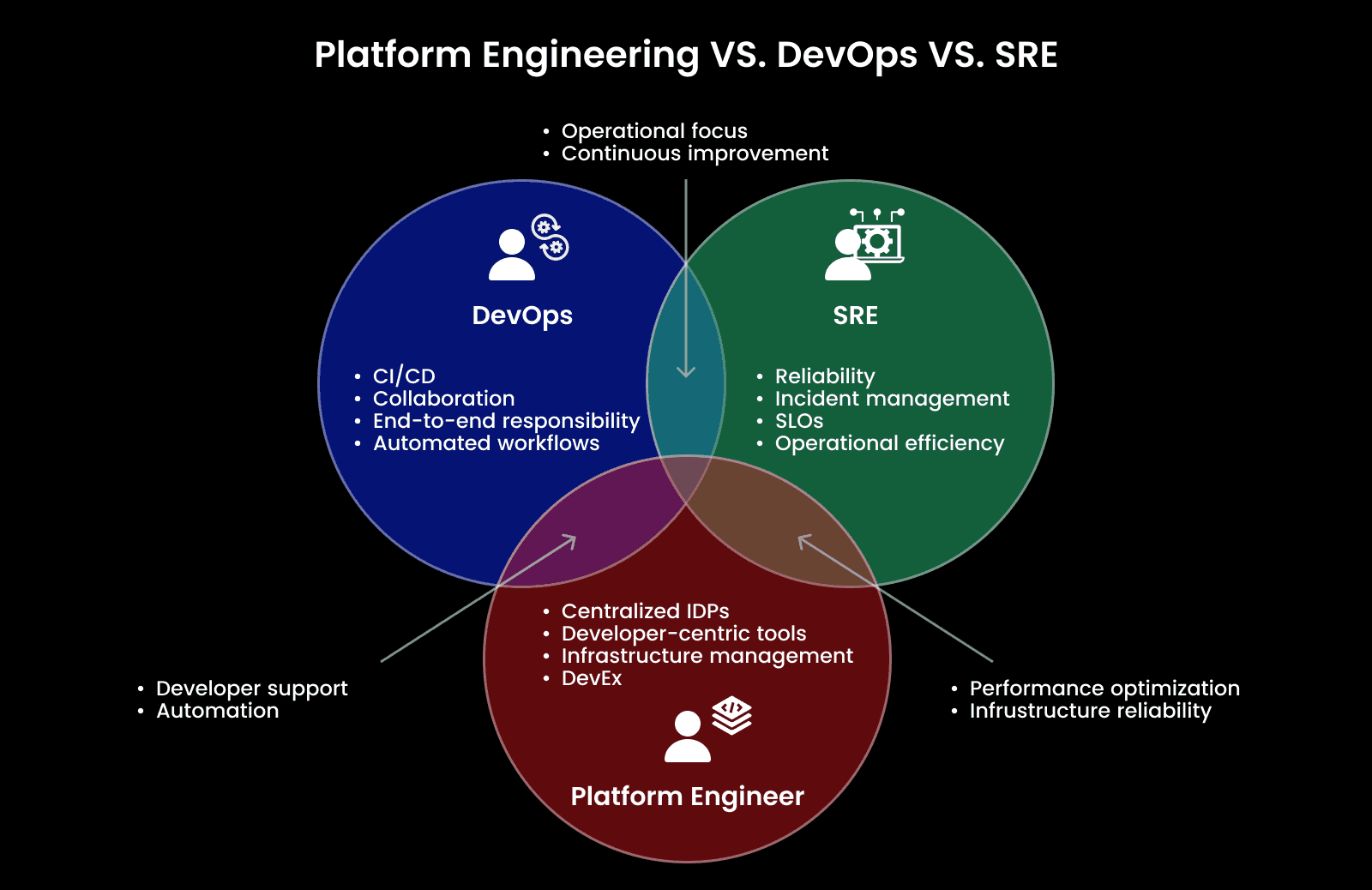
The concept of SRE was first introduced at Google. Engineers there started solving operational problems using software engineering practices. In SRE, system reliability is approached as an engineering problem that can be solved with automation, monitoring, and clearly defined reliability targets.
So, if DevOps asks, “How can we collaborate to ship software efficiently?” SRE asks, “How can we ensure that the software runs reliably and scales well after it’s deployed?”
To answer this question, SRE provides a structured way to manage reliability. It helps teams define how reliable a system should be, measure whether the system meets this goal, and take action when it doesn’t. To manage reliability in this way, SRE uses metrics like Service Level Indicators (SLIs), Service Level Objectives (SLOs), and Service Level Agreements (SLAs):
- An SLI is a metric used to measure the performance of a service. It can track response time, failure rate, availability, or the number of requests the system can handle.
- An SLO is a reliability goal based on one or more SLIs. It describes the level of performance a service should maintain during a certain period. To define these goals, teams often use the four golden signals of system reliability: latency, traffic, errors, and saturation. For instance, a team might set an SLO that the service must be available 99.95% of the time over a 30-day period.
- An SLA is a formal contract that describes the service standards a provider guarantees to its customers. It establishes measurable expectations and specifies the compensation if these expectations aren’t met.
SRE also helps address the misalignment between development and operations described earlier (Dev wants to release new features quickly, while Ops prioritizes stability). SRE resolves this through an error budget. As long as the system operates within its error budget, teams are free to continue releasing new features. If the error budget is spent, further releases may be paused, and the team shifts its focus to improving system stability.
Here are some examples of projects where SRE can particularly prove its value:
- When your environment includes more than three distinct tech stacks, and the points of failure multiply.
- When your systems need to scale horizontally to support more users and higher concurrency, without requiring a new engineer for every additional server or service.
- When your team manages shared infrastructure or platform services used by many other teams, and reliability issues can impact many products at once.
SRE is most effective when the cost of downtime is high and the systems are deeply technical. Overall, the SRE effectiveness depends on the infrastructure the system runs on. If it’s a legacy system with a single point of failure, there is only so much SRE practices can improve.
In these cases, reliability problems are often caused by architectural limitations rather than operational processes. But these limitations can still be addressed. Our engineers often help redesign systems so organizations can successfully adopt SRE practices and achieve higher reliability.
Where Platform Engineering Brings the Most Value
Platform Engineering involves building a shared Internal Developer Platform (IDP) that provides engineers with standardized tools, infrastructure, and workflows. This way, every team doesn’t have to set up its own deployment pipelines, infrastructure configuration, and monitoring systems, since they already have reusable solutions.
So, when it comes to platform engineering vs DevOps comparison, platform engineering focuses on actually creating infrastructure and tools that support DevOps practices.
Speaking of the DevOps Engineer vs Platform Engineer distinction, these roles mirror the focus of the approaches they support: DevOps engineers concentrate on building delivery pipelines and automation, while platform engineers build and maintain the internal platforms that allow developers to spin up a pipeline independently, often without needing to deeply understand the underlying Kubernetes manifests or Terraform modules.
The following types of projects can benefit from having an Internal Developer Platform:
- Complex environments where it can take weeks or even months for a new hire to understand the infrastructure. An IDP helps reduce this period by providing self-service tools that allow engineers to provision what they need without filing a ticket.
- Organizations with multiple development teams. When different teams manage their own services, they may use different tools and approaches, which can make the overall process inconsistent and result in duplicated work or integration difficulties. With an IDP, these teams have standardized workflows, templates, and tools to work more efficiently.
- Cloud-native environments with complex infrastructure. Cloud systems often include many components such as servers, databases, networking, and access permissions. An IDP simplifies the management of these multiple components by providing simple interfaces.
Building an IDP is an investment. Therefore, if an engineering department consists of a handful of developers working on a single technology stack, the benefits may not justify the cost. It would be similar to building a massive factory to produce only ten items.
An IDP is also less useful in the early exploration phase of a project where the system architecture isn’t fully defined yet. At this stage, teams usually focus on rapid prototyping to test ideas before investing in more structured operational practices. So, the goal is to experiment rather than establish standardized processes.
Platform Engineering vs DevOps vs SRE Comparison
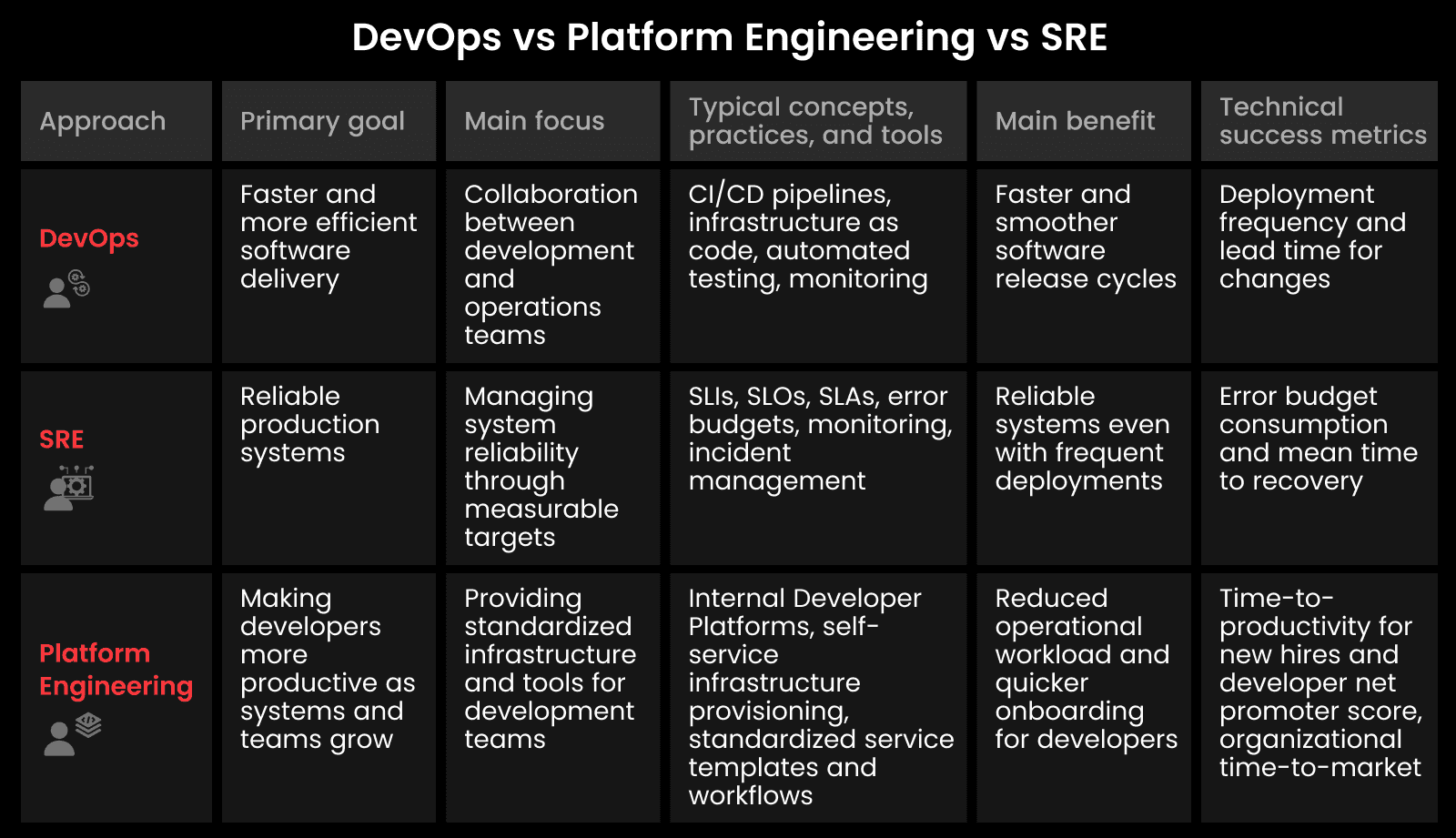
Although DevOps, SRE, and Platform Engineering may be discussed separately, they aren’t mutually exclusive. In many organizations, they’re applied together:
- DevOps improves how software is delivered.
- SRE ensures systems remain reliable once deployed.
- Platform Engineering provides the tools and infrastructure that support development teams.
The table below provides a summary of the main focus areas of these three approaches: DevOps vs Platform Engineering vs SRE.
How to Decide What Your Organization Needs Next
Deciding between DevOps vs Platform Engineering vs SRE depends largely on an organization’s level of maturity and the specific engineering challenges it faces. Use the following criteria when deciding your next step:
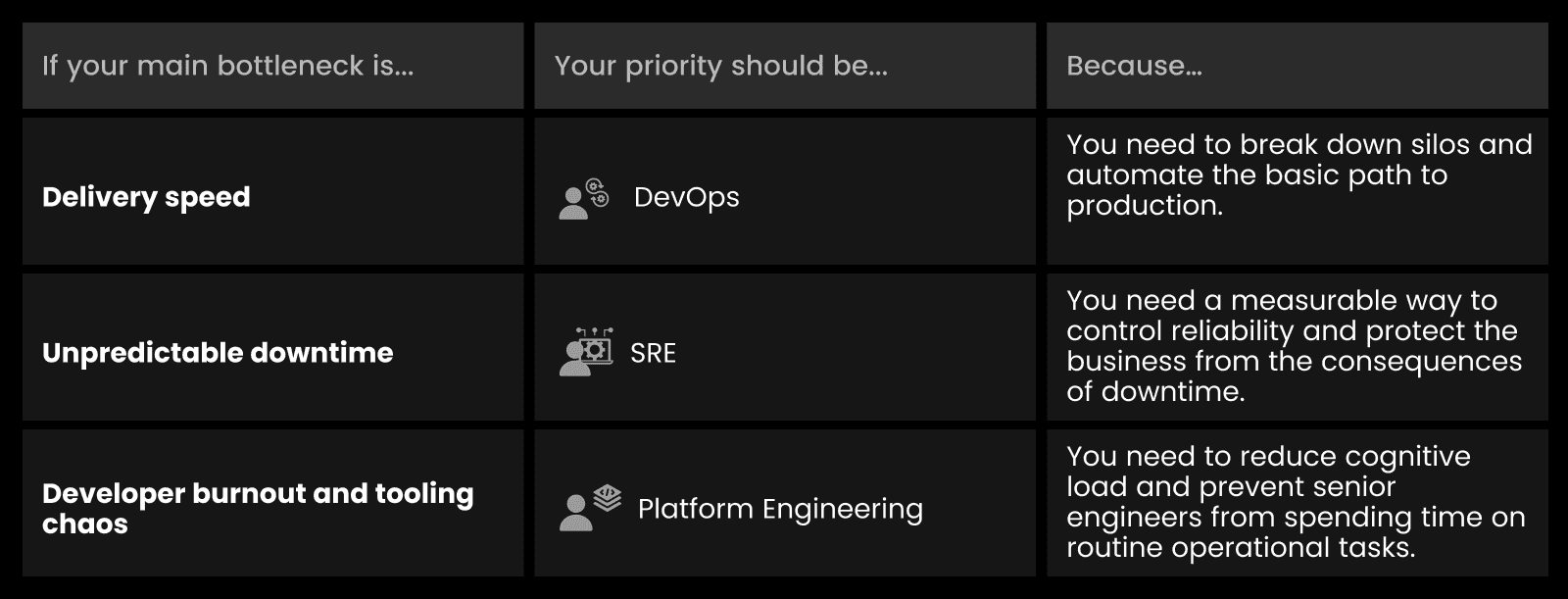
When comparing DevOps vs SRE vs Platform Engineer, we’re looking at distinct roles within engineering teams. As organizations often choose to implement all three approaches together, they engage DevOps, SRE, and Platform Engineers to balance the speed of software delivery, the reliability of production systems, and the ability to scale software development. However, in some companies, engineers in one role may also take on the responsibilities of another, particularly in projects with shifting demands.
Here’s the general description of how the DevOps -> SRE -> Platform Engineering evolution typically happens.
Stage 1: Starting with DevOps
In the early stages of a project or organization, once teams validate that the product solves a real problem, the next priority is establishing a reliable way to build and deliver software. At this point, DevOps practices are often used to make sure developers and operations work toward the same goals.
A CI/CD pipeline is introduced and, at the same time, teams begin to adopt a culture of shared responsibility. Monitoring tools are set up, too, to provide visibility into the system, allowing the team to detect problems as soon as they occur.
Stage 2: Adding SRE as Reliability Becomes Critical
Over time, system failures may start to have a much bigger impact. Downtime can affect thousands of people and lead to financial losses. This is where the organization integrates SRE practices to manage reliability in a more structured way. By defining SLOs and error budgets, the team can measure how reliable the system is and decide when the team must pause to pay down technical debt.
Stage 3: Scaling Development with Platform Engineering
As the organization grows further, more teams begin working on different services and using different technology stacks. The organization adopts Platform Engineering and builds an IDP. This allows the company to scale its systems without a proportional increase in the effort required to manage them.
DevOps vs Platform Engineering vs SRE: Choosing the Right Approach for Your Organization
In the context of Platform Engineering vs DevOps vs SRE, these methodologies aren’t competing — they’re just suited to different levels of operational maturity.
Once you’ve identified which approach aligns with your current scale, what remains is to apply these practices to match your project’s workflows and its technical and business needs. You need to establish reliable delivery pipelines, define meaningful reliability targets, or build an internal platform that provides a frictionless developer experience.
At Janea Systems, we partner with organizations to solve their most complex engineering challenges. Our teams work as an embedded partner to build stable, scalable infrastructure and optimize software performance, from the kernel to the cloud.
We also specialize in AI systems, working across the software stack and supporting clients building solutions such as edge AI devices, ensuring ML workloads run reliably despite strict hardware and power constraints.
Fighting performance bottlenecks or hitting a scalability ceiling? Our Platform Engineering experts are ready to help. Let’s talk!
Related Blogs
Let's talk about your project
Let's talk about your project
Ready to discuss your software engineering needs with our team of experts?