
Industrial Machine Vision: When Testing Becomes the Bottleneck
February 04, 2026
By Anastasiia D.
Machine Vision,
Quality Assurance
Historically, hardware validation followed a linear path: design, build, test, and release. Today, the testing phase for industrial machine vision systems turned into a complex cycle of automated test scripts, environmental controls, and data capture pipelines.
When this system is built on legacy software architecture, it becomes fragile. Even minor hardware changes (like a new lens option for an industrial machine vision camera or a sensor with different sensitivity) can require substantial rewrites of test software, introducing delays that compound quickly.
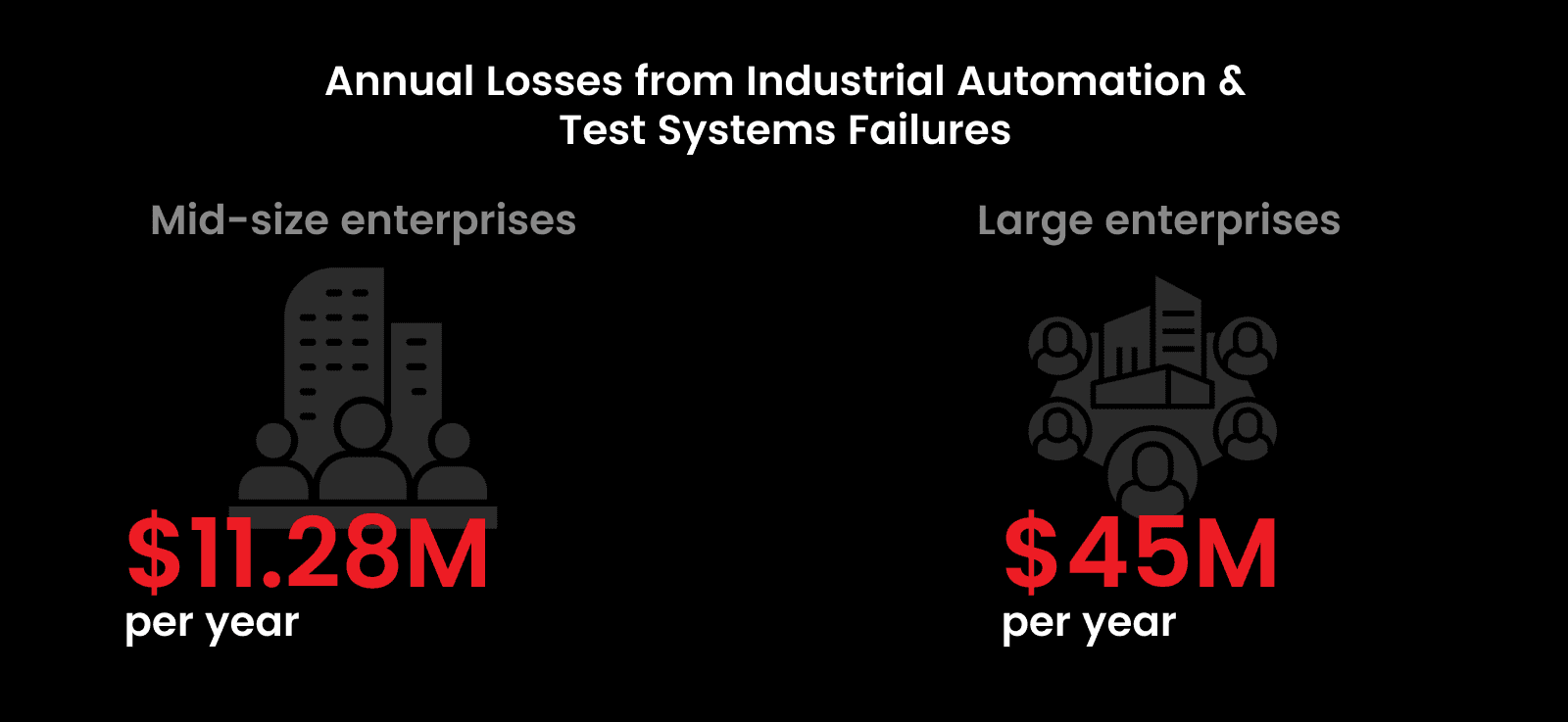
For mid-sized manufacturers deploying industrial cameras for machine vision, inefficiencies in automation and test systems can consume up to 7.5% of annual revenue, which is roughly $11.28 million per year. At large enterprises, annual losses can approach $45 million.
These losses are not simply operational overhead. They point to a deeper issue: software infrastructure that has failed to evolve at the same pace as machine vision technology.
Nearly half of product launches miss their planned release dates, and only 20% of delayed products achieve their internal business targets. When the software toolchain creates constraints, even strong hardware products fail to succeed.
Software Dependency in Machine Vision Systems
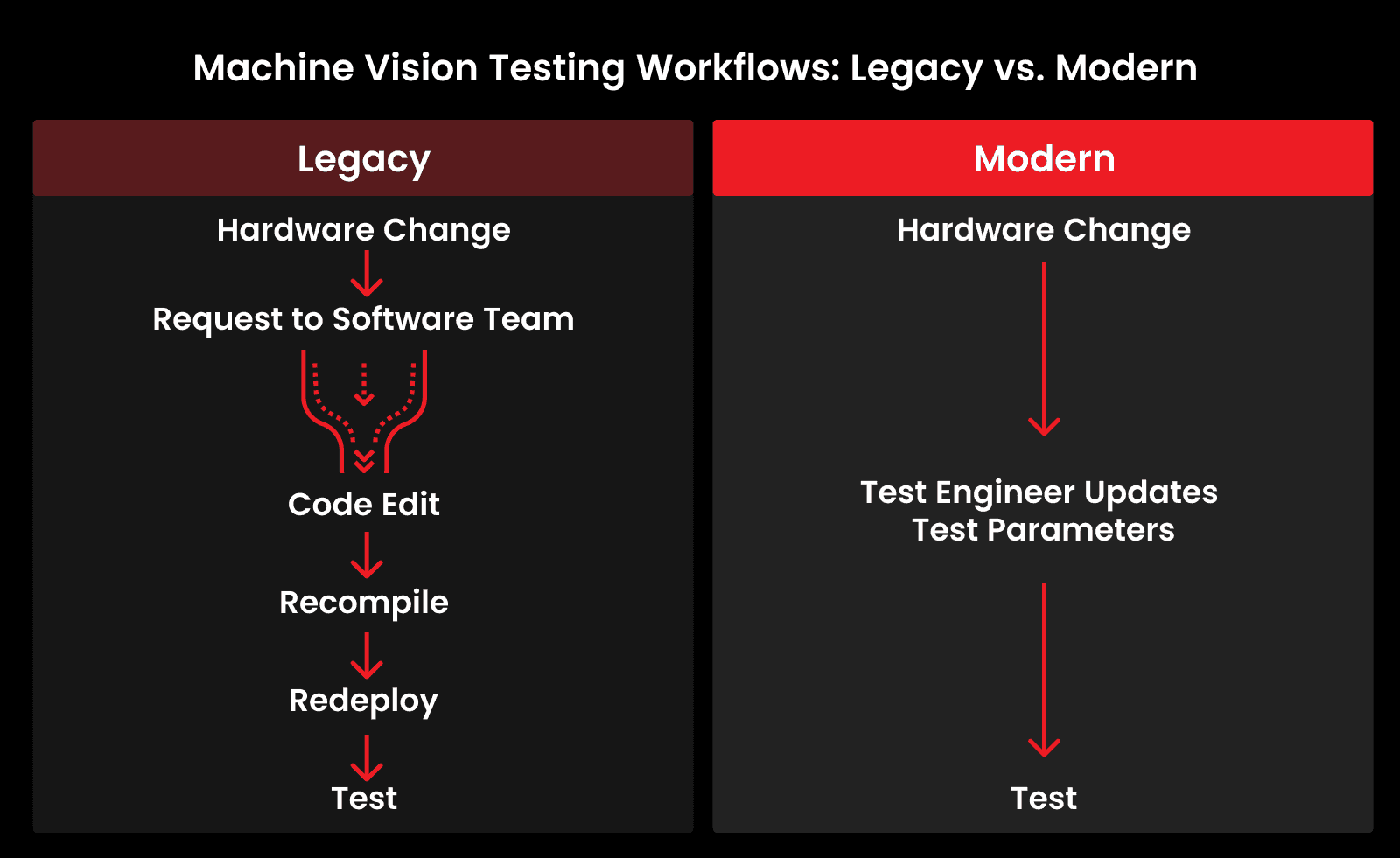
Industrial machine vision systems often depend on software. Testing rules, such as acceptable voltage ranges for stress testing or the required frame rate for image capture, are hard-coded into the machine vision inspection software logic. Test engineers, who understand the physical behavior of the device, don’t have the software knowledge to adjust tests themselves.
Any change requires a handoff to a software engineer to modify code, rebuild the application, and redeploy it. Software dependency stretches feedback cycles from hours to days or weeks (depending on development backlogs).
For example, adding a new industrial machine vision camera model to the test suite requires a software engineer to manually change the source code. Over time, this creates reliance on a small number of individuals with deep, undocumented knowledge of the machine vision system. A single engineer can become the de facto owner of these changes, creating a bottleneck to the whole process.
How Industrial Machine Vision Testing Works
To understand why software flexibility matters, it's important to recognize the demands of industrial machine vision inspection and validation.
Golden Image vs. Algorithmic Validation
Traditional testing often relied on "golden image" comparison — checking if the captured image matched a reference image pixel-for-pixel. While straightforward, this method is fragile and breaks down quickly in real manufacturing environments, where normal variation in lighting, alignment, or optics is unavoidable.
Modern test strategies instead use algorithmic validation. Rather than comparing raw pixels, the software verifies that required features (e.g., a barcode, a fiducial marker) are correctly detected despite minor visual differences. This approach requires integration with machine vision libraries (VisionPro or OpenCV) and executing complex inference tasks as part of the validation loop.
Machine Vision Validation at Scale
Machine vision cameras and sensors are deployed for a range of tasks, including barcode reading to high-precision dimensional inspection. Validating these devices requires long-duration tests, controlled environmental conditions, and repeatable image acquisition patterns.
One of the most significant challenges in extended testing is data volume. For example, running a machine vision camera at just 2 frames per second over a 72-hour test produces more than 500,000 images. When images are stored as high-resolution, uncompressed bitmaps, storage limits on standard test stations are quickly exceeded.
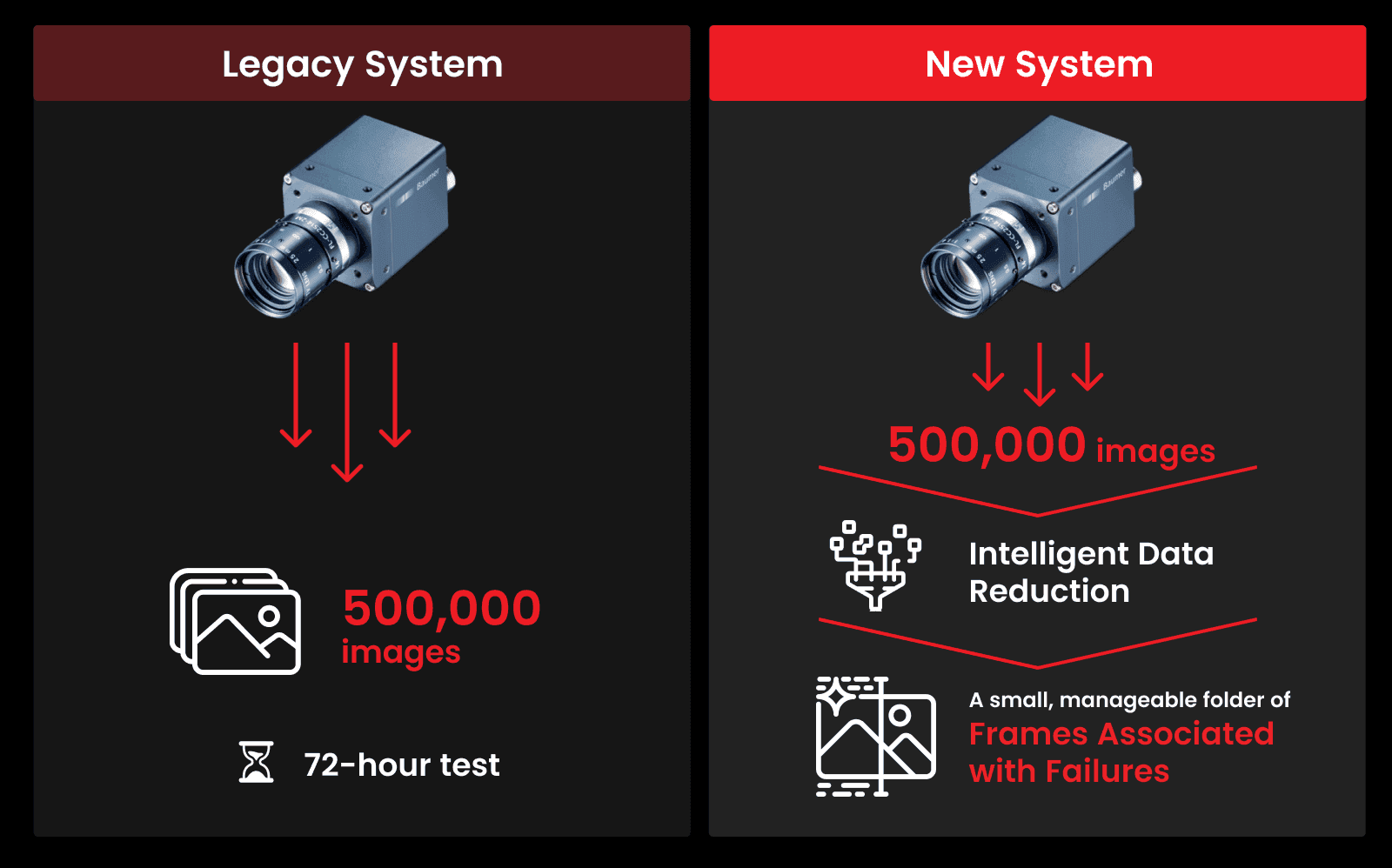
This issue surfaced in the Cognex project. The legacy test system lacked effective controls for disk usage, resulting in full hard drives and failed test runs. A modern test architecture for a machine vision system must account for. Implementing intelligent data reduction, such as saving every nth frame or retaining only frames associated with failures, ensures that tests can be completed without manual intervention.
Creating Testing Solution for Cognex Machine Vision Systems
Cognex, one of the leading machine vision companies, found its Product Assurance Testing (PAT) constrained by a legacy desktop application. Originally built for camera calibration, the software had gradually been repurposed for machine vision inspection without a corresponding architectural redesign.
Several issues defined the day-to-day experience:
- Monolithic architecture: The application combined calibration and testing logic in a tightly coupled C# codebase, making even small changes risky and time-consuming.
- Tribal knowledge: Documentation was sparse, and understanding how the machine vision camera interacted with software required direct input from a few long-tenured engineers.
- Poor usability: The interface exposed internal variables rather than test-relevant parameters, forcing test engineers to work around a developer-centric design.
- Manual dependency chains: Supporting a new machine vision camera variant required editing source code, recompiling, and redeploying the application, often leaving test hardware idle for days.
Janea Systems was brought in to separate the PAT workflow from the legacy architecture and build a dedicated machine vision testing solution. Led by João Reis, the team redesigned the system for clarity, modularity, and long-term maintainability.
Choosing a Sustainable Stack for Machine Vision Software
Selecting the right platform was a strategic decision rather than a purely technical one. Several options were evaluated for the client’s machine vision system:
- Node-RED: Attractive for its visual, flow-based approach, but insufficient for high-throughput image acquisition and misaligned with the client’s existing C# expertise.
- WPF (Windows Presentation Foundation): A proven framework, but one with a diminishing long-term roadmap and limited future investment from Microsoft.
- WinUI 3: A modern Windows UI framework within the Windows App SDK. While newer and less familiar, it offered better performance, modern UI capabilities, and a clearer long-term direction.
The team selected C# with WinUI 3. This choice balanced internal maintainability with the need to support evolving machine vision technology.
Value Delivered to the Cognex Machine Vision Platform
Delivered over a 2,5-month timeline, the new application fundamentally changed how Cognex approached machine vision inspection systems.
Win #1: Configuration Without Code
Test engineers now define new device profiles directly in the UI. Adding a new part number or enabling features such as exposure control or high-resolution imaging no longer requires code changes.
Win #2: Designing for Physical Reality
The system was built with the realities of lab testing in mind:
- Controlled data capture: Engineers can specify image retention rates (for example, saving one frame per minute), preventing disk exhaustion during multi-day tests.
- Improved UI: Test engineers can quickly adjust test parameters in the application, improving iteration time and usability.
Win #3: From Tribal Knowledge to Shared Understanding
Rebuilding the system required reverse-engineering undocumented behavior in the legacy software. This effort surfaced implicit assumptions and formalized them into clear, maintainable specifications. As a result, critical machine vision inspection logic became documented, transparent, and no longer dependent on individual memory.
Edge AI Enablement for Industrial Machine Vision Devices
Although the immediate focus of the Cognex project was reliability testing, it sits within a larger industry shift toward using Edge AI for industrial machine vision systems.
The Challenge of Validating Edge AI Hardware
Validating AI-enabled machine vision cameras is significantly more complex than testing a conventional sensor. Several factors make traditional test approaches ineffective:
- AI models return confidence scores and probabilities rather than binary pass/fail results. Effective validation requires statistical methods, not simple threshold checks.
- Sustained inference workloads generate heat. A device may pass initial functional tests but degrade over time due to thermal throttling after prolonged operation.
- Edge devices operate within strict power envelopes. Testing must confirm that AI workloads remain within allowable limits under real operating conditions.
Janea Systems provides Edge AI Enablement services to address these challenges. Techniques such as model quantization and custom inference runtimes are used to ensure models run reliably on resource-constrained platforms, including ARM64-based devices like industrial machine vision cameras.
Enablement also means testability. The test infrastructure must support deploying different AI models to the device, feeding controlled image datasets, and validating inference behavior.
Backed by more than 20 years of experience in High-Performance Software Engineering, Janea Systems creates systems at the intersection of hardware and software. Our teams design low-latency, resource-aware, scalable architecture, ensuring that Edge AI does not become a bottleneck.
Industrial Machine Vision Testing Modernization: Recommendations for Engineering Leaders
These recommendations focus on the most common failure points in industrial machine vision companies and provide concrete actions to improve reliability, testability, and time to market.
Tip 1: Audit Your Dependencies
Ask a question: “If we need to change the duration of a standard burn-in test, who has to make that change?”
If the answer is “a software engineer needs to modify and recompile code,” your organization is caught in the software dependency trap. Refactor test systems to separate configuration from code. Expose test parameters through configuration layers, so domain experts (test engineers, physicists) can adjust behavior without developer involvement.
Tip 2: Modernize the UX of Internal Tools
Are your internal engineering tools described as “ugly but functional”? “Ugly” usually means hard to use. Poor usability increases errors, slows iteration, and concentrates ownership in the hands of the original developer.
Treat internal tools as first-class products. Invest in modern UI frameworks and user-centered design. As the Cognex case shows, a well-designed interface directly improves throughput and reduces operational friction.
Tip 3: Establish Hardware-Aware CI/CD
Is your release process still based on manual file transfers and ad hoc deployment steps?
Move toward HardwareOps. Implement CI/CD pipelines that automate firmware deployment, test configuration updates, and regression testing. Where possible, use simulators and digital twins to validate changes before they reach physical hardware, reducing coupling between software iteration and hardware availability.
Tip 4: Prioritize Hardware Empathy When Hiring Engineers
Review recent software-related failures with a critical lens. Were the root causes flawed algorithms, or did the issues stem from unaccounted physical constraints like timing assumptions, latency, thermal behavior, or memory pressure?
When building internal teams or selecting external partners, explicitly screen for hardware empathy. Favor engineers and vendors who operate at the intersection of hardware and software and who understand how code behaves on real devices, not just APIs and abstractions.
Janea Systems provides specialized Hardware Optimization services. Our teams design and tune low-level runtimes, so that software executes efficiently on specialized and resource-constrained hardware.
In one engagement, Janea optimized Node.js for Windows, delivering a 40% performance improvement by accounting for OS-specific file system behavior.
If hardware behavior is limiting your system’s performance or reliability, Janea Systems can help. Contact us via the form below, and we will find solutions for your performance constraints.
Frequently Asked Questions
Industrial machine vision refers to purpose-built vision systems used in manufacturing to perform deterministic, real-time inspection and measurement tasks. Unlike computer vision, which is often software-first and optimized for flexibility or research, industrial machine vision systems are tightly coupled with hardware, operate under strict timing constraints, and prioritize reliability, repeatability, and deterministic behavior.
Industrial machine vision systems are used for automated inspection, quality control, barcode reading, dimensional measurement, defect detection, and guidance of robotic systems. These systems rely on machine vision cameras, controlled lighting, and specialized machine vision software to ensure consistent performance in high-speed, high-volume production environments.
To validate machine vision inspection systems, testing must go beyond basic functional checks. Effective validation includes long-duration testing, controlled environmental variation, high-volume image acquisition, and algorithmic validation. Scalable validation also requires intelligent data management to handle large image volumes generated by industrial machine vision cameras.
Legacy software slows industrial machine vision development because test logic and hardware assumptions are often hard-coded into the application. Even minor changes to a machine vision system, such as a new camera variant or updated sensor behavior, can require code changes, recompilation, and redeployment. This creates dependency bottlenecks and limits the ability to scale machine vision solutions efficiently.
Related Blogs
Let's talk about your project
Let's talk about your project
Ready to discuss your software engineering needs with our team of experts?