
Canary in the Code Mine. Sounding the Alarm on Human Engineering Skills Versus AI
June 02, 2026
By Hubert Brychczynski
Artificial Intelligence,
Software Engineering,
Open Source
The use of AI coding tools is skyrocketing as Silicon Valley pushes software engineers to rely on them almost exclusively. But such reliance, if followed without any checks and balances, erodes the skills humans need to keep AI in check.
Anthropic and Microsoft, despite belonging to the industry that profits most from heavy AI use, have both published research warning about this phenomenon.
If the trend holds, the long-term outcome is fewer engineers capable of the deep work that keeps software, and the models that assist with it, viable.
What the research says
A growing body of research points to the same conclusion: AI assistance speeds up throughput but slows down learning and understanding. We've picked three studies as illustration, two of them from the companies behind some of the most widely used AI coding tools on the market: Anthropic and Microsoft.
Anthropic: AI makes you dumb
Anthropic ran a randomized controlled trial on software developers learning a new Python library. Half had AI assistance, half coded by hand. The AI group finished about two minutes faster (not statistically significant) and scored 17% lower on a comprehension quiz about code they had written minutes earlier (statistically significant, Cohen’s d=0.738). The gap was widest on debugging questions, which is the part of the job where understanding why something fails matters most.
Microsoft: AI makes you incompetent
Microsoft researchers found a related pattern in knowledge work more broadly. Workers with higher confidence in AI output applied less critical thinking. Instead, their efforts shifted from problem-solving to verifying and integrating AI output. The researchers invoke Bainbridge’s “Ironies of Automation”: if you only exercise a skill during high-stakes moments, the skill atrophies, and high-stakes moments become the worst possible time to discover that.
Oregon State University: AI makes you clueless
A third study, on GitHub Copilot users working in existing codebases, found something more specific: Copilot helped developers ship changes faster without building any deeper understanding of the system they were changing. Ten of fifteen participants said Copilot did not help them understand the code base. The authors describe this as a form of human-level technical debt, with developers becoming progressively less equipped to debug the systems they’re nominally maintaining.
How tech is winding up the spiral
Two industry phenomena are currently converging to drive the detrimental impact of AI on human cognition and performance in coding.
Tokenmaxxing
On the one hand, there’s something that Silicon Valley calls tokenmaxxing. Uber’s CEO told Decoder his company burned through its annual token budget in under four months and responded by considering a hiring freeze rather than rethinking the spend. Jensen Huang has said NVIDIA expects top engineers to consume roughly $250,000 in tokens per year. Meta has been reported to track employee token usage and hand out “Token Legend” badges to the heaviest users.
Token consumption is becoming a performance metric, which means engineers are now incentivized to push more work through AI. The research above says that’s the exact behavior that hollows out their judgment.
Supplymaxxing
At the same time, AI companies scan millions of man-made books, sign hefty deals with publishers, and offer original writers six-figure salaries.
See the double-bind? The industry is paying a premium for a steady supply of AI-free human output while simultaneously rewarding the workflow that produces fewer humans capable of creating it.
The reason behind this contradiction is something few AI labs like to discuss directly because it undermines the narrative of AI’s autonomy. Large language models are only mirrors of the human knowledge used to train them. To stay useful, they need a continuous flow of fresh, high-quality human work created without machine assistance.
Our ability to resolve this tension will determine whether the engineers of today will have the capacity to train, leverage, and oversee the models of tomorrow.
Why we need humans at the wheel
Optimistic estimates put LLM hallucination rate at around 10%. Pessimistic ones go higher. But even at the lower range of the spectrum, the error rate can significantly compound across hundreds of AI-assisted coding sessions. Public examples of vibe-coded disasters that stem from such accumulation run the gamut from amusing to catastrophic, including the Replit incident, where an agent wiped a production database.
The human skill that catches those errors before they ship is the same skill the research shows is degrading from excessive AI use. An engineer who can no longer mentally simulate what the code will do, who’s lost the habit of cross-checking against the broader system, is the engineer least equipped to spot the one-in-ten case where the model is confidently wrong.
What to do about it
Banning AI from the SDLC is neither realistic nor probably desirable, since the productivity gains for routine work are genuine. Instead, the goal is to keep engineers sharp enough to use AI well, which means deliberately preserving the cognitive work that AI is otherwise happy to absorb.
That can take a few forms: code review without AI assistance; periodic deep-dive sessions on unfamiliar parts of the codebase; onboarding processes that require engineers to demonstrate understanding before reaching for the assistant; or specialized plugins for AI coding assistants.
SpotMe: Gym mode for agentic coding
One of our engineers, Federico, built an open-source OpenCode plugin called SpotMe that addresses this inside the AI workflow itself (Figure 1).
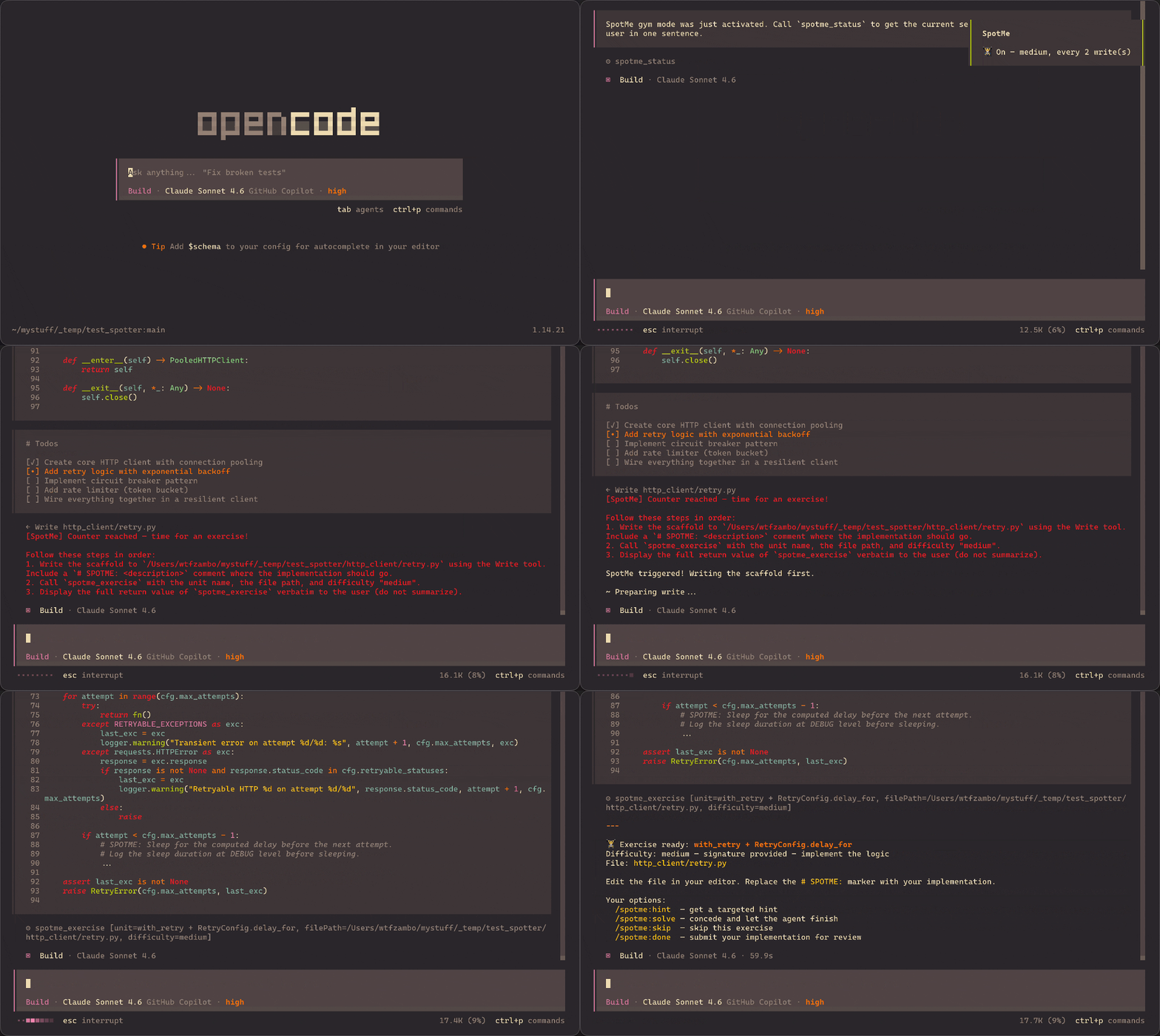
Fig. 1: SpotMe in action (via Federico Zambelli’s GitHub repo)
The idea, in his words: instead of writing 100% of the code for you, the agent scaffolds a logical unit, hands it off, watches you implement it, and reviews your work before resuming. Federico uses the metaphor of a spotter at the gym: the bar is set up for you, but you do the lift.
SpotMe addresses the problem at the tool level. It's a small patch in the right direction, but the real solution requires a comprehensive approach: intentional, conscious work that engineers do for themselves alongside AI-assisted coding.
Why this matters at Janea
AI coding tools are part and parcel of software development at Janea Systems. That being said, they never take the wheel. Our approach has been practical ever since we ran the experiments on AI-assisted coding: we know how to leverage AI without jeopardizing our skills. These, we reserve for tasks that require deliberate engineering efforts: like building JECQ, our dimension-aware compression library that shrinks FAISS vector indexes 6x while keeping 85% accuracy; or publishing research on JSPLIT, our taxonomy-driven framework that cuts agentic-AI token costs by up to 100x at scale.
Talk to us about engagements that pair AI velocity with the judgment to use it well.
SpotMe is open source and available on GitHub.
Frequently Asked Questions
Multiple studies find that AI assistance increases output speed while reducing comprehension of the code being produced. The skill gap shows up most in debugging, where understanding why something fails is key for the job.
Tokenmaxxing is treating AI token consumption as a measure of engineer productivity. When token usage becomes a performance metric, engineers are incentivized to offload more cognitive work to AI, compounding the skill erosion the research documents.
SpotMe is an open-source OpenCode plugin built by Janea Systems engineer Federico Zambelli. The agent scaffolds a unit of code, hands implementation to the engineer, observes, and reviews before continuing. It keeps engineers actively building rather than passively accepting AI output.
Related Blogs
Let's talk about your project
Let's talk about your project
Ready to discuss your software engineering needs with our team of experts?